
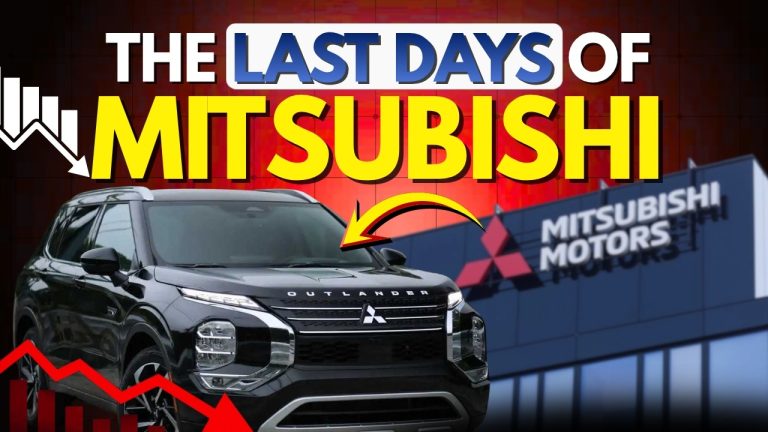
Mitsubishi Motors is in much bigger trouble than people realise, according to Sam Evans, who says the Japanese carmaker faces not just an EV problem but a scale, profitability and strategy problem that could end in bankruptcy, restructuring or a takeover. Sam, who previously predicted Nissan would hit huge trouble, believes Mitsubishi may be in just as much trouble as Nissan.
Shrinking profits at a small automaker
Last financial year, Mitsubishi sold around 797,000 vehicles worldwide, well short of a million, which Sam says already makes it a small global automaker. The more worrying number is profit. Mitsubishi’s operating profit fell by around 46%, net income fell by 76% and operating margins dropped to just 2.6%.
In US dollars, Mitsubishi made a profit of $63 million (about A$87 million). Sam calls this a minuscule profit for a global car company, and notes it comes before the full force of the electric vehicle transition hits.
Get the latest EV news first. Follow us on:
The market is moving away from Mitsubishi’s vehicles
Sam says Mitsubishi’s sales are going to fall sharply because the market is moving away from the vehicles it relies on. As battery electric cars become cheaper every year, gain longer range and become more common, he believes more buyers will stop looking at petrol and diesel SUVs altogether. For people not ready for a full EV, long-range plug-in hybrids and EREVs are becoming a good compromise. In China, these vehicles can drive long distances on electricity, use petrol only as a backup and remove most of the range anxiety argument.
Mitsubishi’s current strengths are the Triton, the Outlander PHEV with its short EV-only range, ASX petrol SUVs, regional hybrids and future Pajero-style vehicles, which are apparently coming within a few months. Sam says these only work if buyers still want petrol, diesel and short-range plug-in hybrids, and that they already look dated.
Sam suggests Mitsubishi’s sales could fall by 50%, a figure he considers conservative given the current disruption. If the global market moves quickly to EVs, that would take Mitsubishi from just under 800,000 sales a year to around 400,000.
Why falling volume breaks the business model
Car companies carry enormous fixed costs, including factories, engineering, crash testing, compliance, warranties, dealers, spare parts, software, logistics, marketing, tooling and model development. If sales halve, Sam says, those costs do not halve. They are spread across fewer vehicles, so the cost of building each Mitsubishi rises. He notes that some companies say a carmaker needs to sell a minimum of 500,000 vehicles a year to make a profit, and even then may only break even.
Sam says this is the opposite of what is happening at BYD, Geely, SAIC, Tesla, Hyundai and Kia. These companies are scaling EV production, improving platforms, reducing part counts, getting batteries cheaper and integrating them more efficiently, and using their scale to force suppliers to cut costs, with tools like gigacasting and structural battery packs. He describes this as manufacturing learning curves: the company with rising volume gets cheaper, faster and better, while the one with falling volume gets more expensive, slower and weaker.
Sam compares Mitsubishi to Kodak and BlackBerry. Kodak understood digital photography existed and BlackBerry understood touchscreens existed, but their old profit machines trapped them and they moved too slowly. Sam says Mitsubishi is in exactly the same trap. If the global market becomes 80% electric somewhere between 2031 and 2035, he says Mitsubishi intends to fight over the leftover 20% against Toyota, Honda, General Motors, Ford, Isuzu, Mazda, Hyundai, Kia, Great Wall Motors, BYD, Volkswagen, Chery and others, and that it would be lucky to get 1% of that segment.
A borrowed EV strategy
Sam says Mitsubishi is not building a serious EV business but borrowing one. For Australia and New Zealand, its future EV, one model and maybe two, is not developed by Mitsubishi at all but by Foxtron, linked to iPhone maker Foxconn, which has never made cars before. The vehicles will be built in Taiwan and sold as Mitsubishis. In North America, Mitsubishi is hoping to rebadge Nissan vehicles. Mitsubishi also left China after, as Sam puts it, basically going bankrupt there a few years ago.
Sam calls this a survival-through-borrowing strategy that will not work. He says Nissan is not in a position to rescue Mitsubishi, let alone itself, pointing to falling sales, weak profitability, factory closures including seven factories, the sale of its headquarters, restructuring with tens of thousands of job cuts, and EVs that cannot compete with China. He doubts Nissan will even be around in 2031 or 2035.
Sam also says Foxconn is not a charity. The developer, the contract manufacturer, Mitsubishi, the importer or distributor and the dealer all need a margin, which he says means Mitsubishi gets an expensive outsourced EV rather than a low-cost platform. Mitsubishi does not control the battery supply, platform, software, factory or cost structure. Sam asks how Mitsubishi can make money selling a rebadged EV that is not cheaper, more advanced or more desirable than the competition, and calls the approach a managed decline.
Sam, who lived in Taiwan for a year, says Taiwan excels at semiconductors and electronics but has almost none of China’s EV supply chain: battery makers, cathode and anode suppliers, motors, inverters, thermal systems, castings, software teams, low-cost components, massive domestic demand and extreme price competition. He warns Mitsubishi could end up selling EVs with higher costs, lower scale, weaker software, less battery leverage, more middlemen and no price advantage.
Assets that may not be worth their book value
Sam rejects the argument that Mitsubishi’s billions in assets will protect it, saying legacy factories are only valuable if they build vehicles people want. He points to Hyundai’s factory in China, which opened in 2017 at a cost of $1.2 billion (~AUD 1.8 billion). After Hyundai’s China sales fell, the plant was closed, listed for sale and sold for $226 million (~AUD 341 million). Sam stresses he is not criticising Hyundai, but says second-hand factories are commonly sold for a fraction of their book value.
He says internal combustion factories, tooling for old vehicles and legacy platforms are not worth book value, noting many former combustion-car factories in China now sit mothballed. A dealer network, too, can become a liability without competitive products to sell. In a rapid EV transition, Sam says, some of these assets become liabilities.
What Sam thinks happens next
Sam believes Mitsubishi could survive as a badge for a while, but that is not the same as surviving as a real automaker, comparing it to MG, which nobody thinks is really a British brand building cars in the UK. If the platform, batteries, software, factory and economics all come from someone else, he says, Mitsubishi is just renting someone else’s future.
If EV adoption slows, or hybrids and plug-in hybrids stay popular well into the 2030s, which Sam considers highly unlikely, Mitsubishi might continue as a niche SUV and ute company. But if EVs reach 70% or 80% of global sales, he says its current strategy is doomed and its chance of remaining an independent global carmaker is non-existent. He says AI platforms he checked put its chances at 5 to 10%, with a higher chance of surviving as a smaller, rebadged, alliance-dependent regional badge, possibly bought by a Chinese car company. Sam sees the chance of major restructuring, merger, absorption, retreat from major markets or strategic irrelevance as extremely high.
Sam concludes that unless Mitsubishi finds an EV strategy soon, it risks becoming the next Kodak or BlackBerry, remembered alongside Nissan and Fisker as companies that saw the future but could not move their business into it quickly or profitably enough.
