
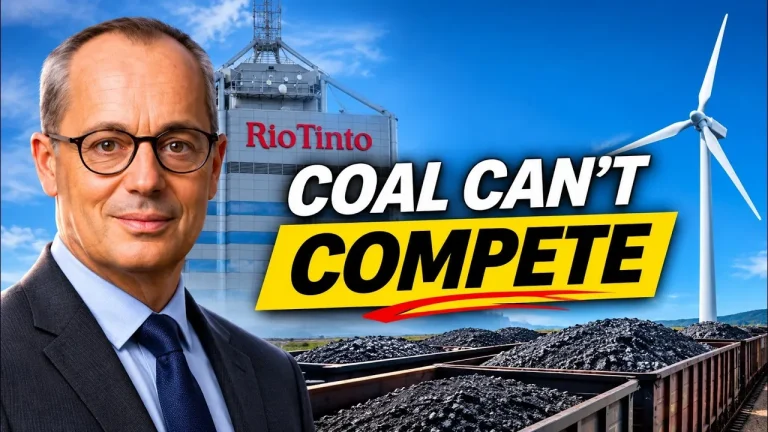
Rio Tinto, one of the world’s largest mining companies, has declared that coal power cannot compete and is investing billions of dollars to prove it. Jérôme Pécresse, head of Rio Tinto’s aluminium business, explained that the company’s aluminium smelters—among the most energy-hungry factories on any power grid—are making a major shift away from coal. The Tomago smelter in New South Wales, Australia’s single biggest power user, consumes 950 megawatts of electricity continuously. Its sister smelter in Queensland uses about one tenth of that state’s entire electricity supply.
Decades of Coal Power for Heavy Industry
For decades, both smelters operated on coal, with the argument that heavy industry required coal because wind and solar could not reliably run such facilities. However, Rio Tinto now says the opposite. Pécresse told Renew Economy that the price of coal power has risen so sharply that contracts based on coal would make the smelters uncompetitive. Sam Evans notes that while Pécresse did not mention it, renewable energy costs have also fallen significantly.
Massive Investment in Renewables
Rio Tinto is responding by backing A$7.5 billion (~$4.98 billion) of new wind, solar, and battery projects in Queensland. In New South Wales, the Tomago smelter will move to a long-term renewable electricity contract with government support. The shift is driven by economics: Rio Tinto is making the move because renewable energy is cheaper. Sam emphasizes that this decision is not coming from environmental groups but from the company that pays the power bills.
Get the latest EV news first. Follow us on:
Political Debate and Market Realities
Some politicians continue to argue that only coal can keep smelters open, but Sam describes these views as out of touch. He points out that Rio Tinto’s decision demonstrates that renewables can power even the most demanding industrial sites at lower cost.
What This Means for Coal and Industry
Sam Evans believes that if the largest power user in the country can switch to renewables and save money, it raises questions about the future role of coal in any sector. He argues that coal power is finished and urges those working in the coal industry to consider other career options, stating that the transition is now just a matter of time.
