
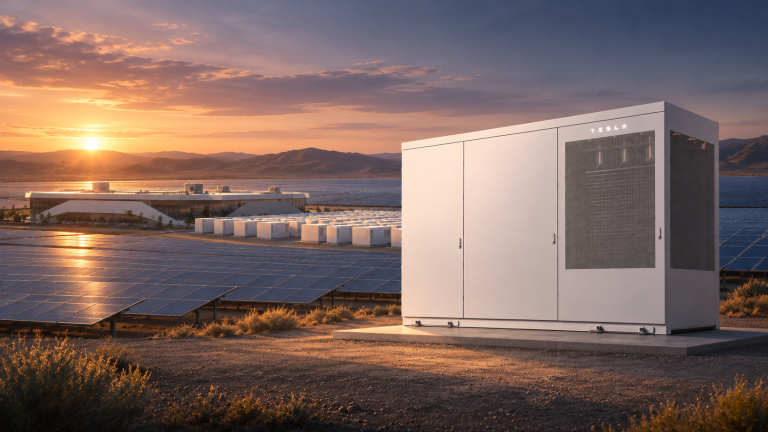
Tesla has unveiled Powercore, a 7.4 MW solid-state transformer planned to begin operating in 2027. It combines three devices in one unit to reduce equipment needs for battery storage, solar projects, data centres and EV charging.
Power output, efficiency and servicing
Powercore combines a transformer, inverter and circuit breaker in one medium-voltage unit. The integrated design reduces electricity conversion losses compared with using a separate inverter and transformer.
Get the latest EV news first. Follow us on:
It delivers continuous apparent power of 9 MVA at an alternating-current voltage of 34.5 kV. Its supported alternating-current voltage range runs from 10 kV to 34.5 kV, while peak efficiency reaches 98.86%.
Field servicing does not require replacement of the entire unit, thanks to its modular, oil-free design. Its operating temperature range extends from -40°C to 55°C, and warranty coverage is available for up to 25 years.
Battery connections and grid support
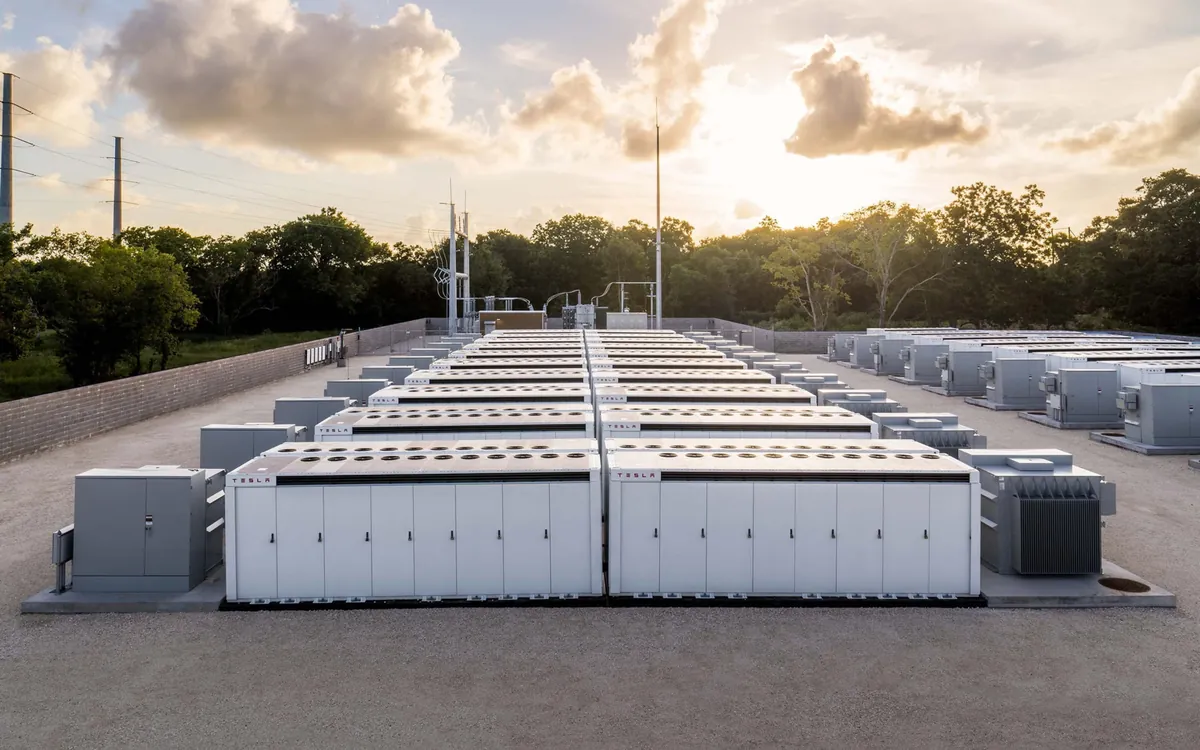
Powercore connects directly to Megapack batteries through direct-current bus connections. The combined system arrives at the project site already assembled, reducing the electrical installation work needed there.
Current battery and solar project layouts use a separate inverter and transformer. Combining those functions reduces the amount of equipment and the space it occupies. Conventional transformer lead times reach up to 4 years.
Powercore supports grid-forming technology to regulate voltage and frequency, with peak grid-forming power support of 10 MVA. Reactive power support and synthetic inertia are also capabilities it offers when coupled with battery storage.
At a data centre, Powercore and Megapack can work together to smooth voltage oscillations and stabilise the grid. Fault clearance takes 100 microseconds with its solid-state circuit breaker—about 1,000 times faster than with traditional equipment.
Solar, data centres and EV charging
For large solar installations, Powercore serves as a central inverter, converting the direct-current electricity generated by solar panels. It supports solar systems operating at both 1,500 V and 2,000 V direct current.
Tesla is also working with NVIDIA towards Powercore certification and qualification under the NVIDIA DSX Ready program.
EV charging infrastructure is another intended application for the unit.

US manufacturing and a planned 2027 start
Powercore is manufactured in the United States. Tesla has scheduled its operating start for 2027, but has not announced pricing.
Why it matters
For EV charging and energy-storage projects, Powercore offers a smaller equipment footprint and less installation work when paired with Megapack batteries. Project buyers can weigh those benefits against their site requirements, but the planned operating date puts deployment in the future rather than making it an immediate option.
Key Specs
- Continuous power output: 7.4 MW / 9 MVA at 34.5 kV AC
- Peak grid-forming power support: 10 MVA
- Peak efficiency: 98.86%
- Fault clearing time: 100 microseconds
- Operating temperature: -40°C to 55°C
- Warranty: Up to 25 years
- Planned operating start: 2027
✎ Images and news sourced from: x.com, pv-tech.org, pv-magazine-usa.com, datacenterdynamics.com, teslarati.com, taiyangnews.info, notateslaapp.com, investors.com, tesla.com, nvidia.com.
