
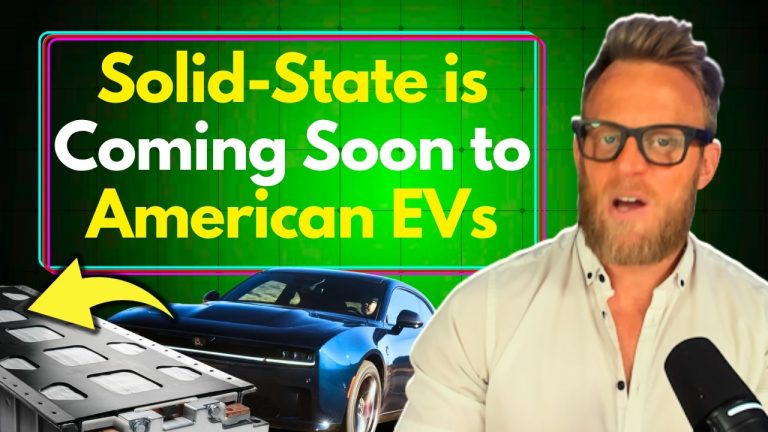
Stellantis has fitted a Dodge Charger Daytona with solid-state battery cells made in the United States by American battery maker Factorial, and the car is now on the road in a testing program. Sam Evans believes the electric muscle car can almost certainly travel more than 1,000 km (more than 650 miles) on a charge, although its exact range has not been revealed.
A Solid-State Dodge Charger
Sam notes that the Dodge Charger is very heavy, so a range of more than 1,000 km in the real world, and not just in theory, would be remarkable. He says solid-state batteries are going to rewrite the rules for EVs, and that nearly every major automaker has a team planning to produce them in the next few years. Stellantis is one of them, and it has been testing the US-made cells in Dodge muscle cars for more than a few months.
According to the company, the cells were built into the battery pack using a new mechanical architecture designed in house. The pack size and the car’s exact driving range have not been disclosed.
Get the latest EV news first. Follow us on:
What the Factorial Cells Can Do
Factorial’s cells have an energy density of 375 Wh per kg. They can charge from 15 to 90 per cent in 18 minutes, which Sam says is “not really all that fast” but fast enough. They can operate in temperatures from -30°C to 45°C (-22°F to 113°F).
Sam says the 45°C upper limit sounds like a bit of an issue, because temperatures sometimes go higher than that. He also points out that battery management systems can keep batteries cool in hot conditions.
The Real Test: Battery Life
Stellantis is starting a road testing program for the solid-state pack. It wants to confirm that the pack achieves the range and charging speeds it should, and that it can replace the lithium iron phosphate and NMC cells used in EVs in the United States today.
Sam believes the real focus of the testing is something the company is not saying publicly: how many charge cycles the batteries can manage in the real world. He says the main reason solid-state batteries are not already in EVs is not that they don’t work, but that they degrade too quickly. In his view, that is why Mercedes-Benz and Dodge are testing these batteries on the road rather than only in a laboratory.
Factorial’s Track Record
Factorial has financial backing from Mercedes-Benz, Hyundai, Kia and Stellantis. In 2025, a Mercedes-Benz EQS prototype drove 750 miles on a Factorial solid-state pack and finished with an estimated 85 miles of range left. That suggests the car could have covered about 835 miles, which Sam puts at about 1,350 km. Sam says that if that car can do 835 miles, then almost certainly the Dodge can do more than 1,000 km. He adds that the company has probably learned a lot since that drive a year ago.
Factorial’s chief executive said the company was “deeply honored” to work with Stellantis, “one of the world’s great mass market automakers,” on the STLA Large-based development car. “What we built together from cell chemistry to pack architecture to enable real world road testing is exactly the kind of deep full stack collaboration that solid state has always required,” the chief executive said.
When Could These Batteries Reach Showrooms?
Stellantis has not said when it will start selling cars with these batteries. Sam’s guess is one or two years away. He points out that the energy density is around 35 to 40 per cent higher than that of the NMC packs in current EVs such as the Tesla Model 3 and Model Y, and he calls that a game changer.
Sam also asks why Toyota test vehicles with solid-state packs are not on the road. Toyota has said it has been working on solid-state batteries since 2014 and has had them since 2018. Factorial, by contrast, is already putting its batteries into cars from several brands. Based on that, Sam reckons there will be EVs with Factorial solid-state batteries within two years. He says this would be good news for shareholders. He admits he does not know for sure, but believes it is very likely.
