
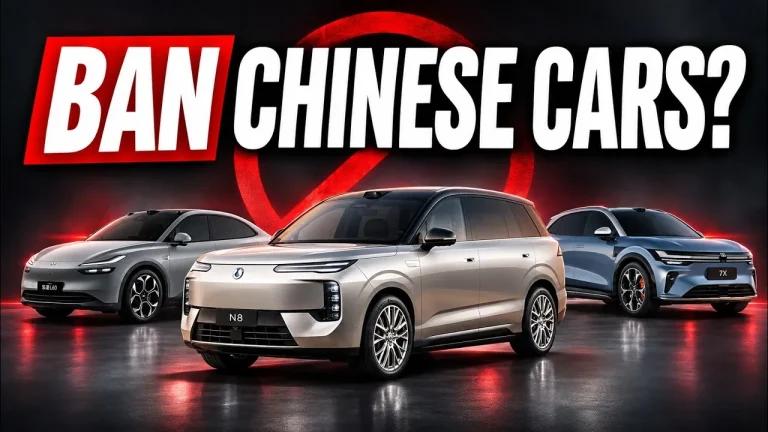
America’s biggest carmakers have formally asked Congress to permanently ban Chinese cars from the US market. This request comes from the Alliance for Automotive Innovation, the main lobby group representing nearly every major automaker in the country, including Ford, General Motors, Toyota, Volkswagen, and Hyundai. The group is pushing for a total ban, not just higher tariffs, on all Chinese vehicles.
Security Concerns Over Connected Cars
The Alliance’s first argument is national security. Modern vehicles are packed with cameras, microphones, and internet connectivity, and the group claims that cars linked to China shouldn’t be allowed to collect data on American roads. I think they have a valid point about the risks of data collection and privacy. However, I also believe there are ways to address these concerns without a total ban, such as ensuring no data is collected.
Competition and the European Example
The second, and probably bigger, reason the Alliance gives is competition. They’re surprisingly open about this. They point to Europe, where in the first eight months of this year, more than 1.1 million Chinese-built vehicles were imported—already surpassing last year’s total. In the US, Chinese brands are already mostly shut out, with tariffs over 100 percent. Starting with next year’s models, new rules will also block vehicles using Chinese software, even if those cars are built in American factories. The Alliance wants these restrictions written into permanent law.
Get the latest EV news first. Follow us on:
Political Support and a Presidential Twist
A bill to permanently ban Chinese cars has found support from both parties in the Senate. However, President Trump has said he would welcome Chinese carmakers if they build vehicles in America and hire American workers. This adds a twist to the debate about whether to block Chinese brands entirely or allow them to compete if they invest locally.
What This Means for American Buyers
Supporters of the ban argue it protects American jobs and private data. Critics, however, say it just keeps car prices and profit margins high. I agree with the critics. The average new car in the US now costs more than $50,000 (~AUD 74,936), which is a significant amount. In countries like Australia and Britain, buyers already have the option to choose Chinese cars, but Americans are still waiting to see if they’ll ever get that choice. If the Alliance for Automotive Innovation gets its way, Americans may never see Chinese EVs on their roads, even if those vehicles are brought in from Mexico or Canada. I think the Alliance will try to block every single one.
