
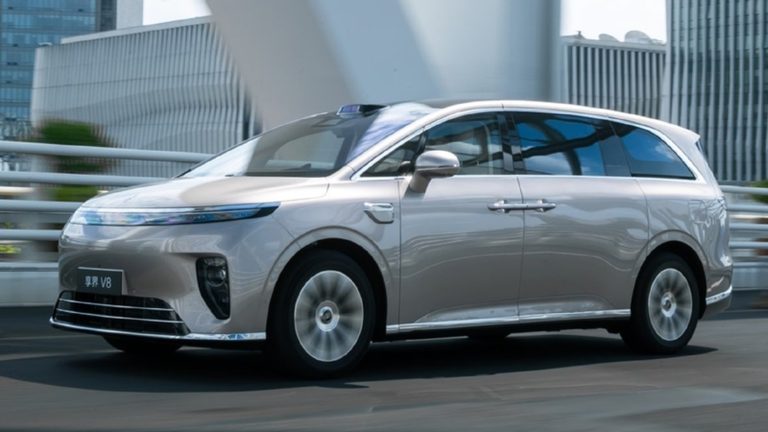
The Stelato V8 has begun China’s first cross-city Level 3 highway road tests, at speeds up to 120 km per hour. The programme takes its testing beyond a single city to highways connecting cities.
Lane changes and highway ramps
The testing programme was announced on November 17. For the Stelato/HIMA brand, the V8 marks its MPV debut.
The V8’s driving system supports lane changes for navigation, driving efficiency and safety. It can also handle approaches to ramps and travel between highways.
Get the latest EV news first. Follow us on:
Before merging onto a ramp, the system can change lanes early or slow down to avoid a hazard. It also supports travel through ramps connecting one highway to another.
The system can activate in light-to-moderate rain, in snow and at night.
Four LiDAR units and simulation testing
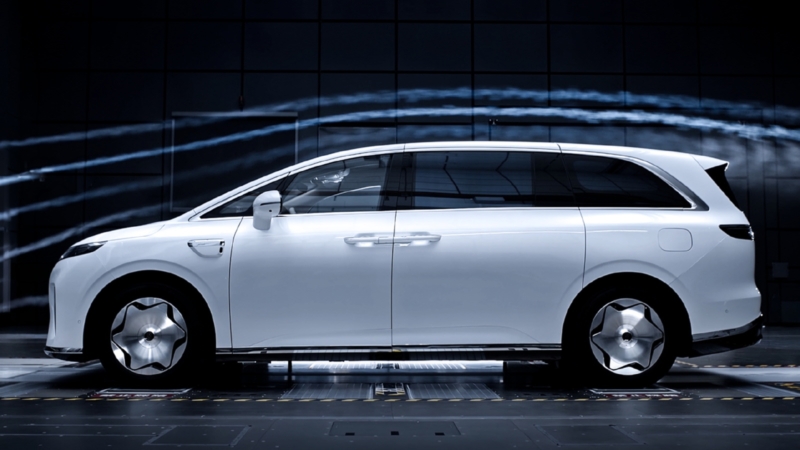
The V8 was designed around a Level 3 autonomous driving architecture and uses Huawei’s Qiankun Intelligent Driving ADS 5.0 system.
The roof-mounted unit is an 896-line, dual-optical-path, image-grade LiDAR. The vehicle also has eight redundancy designs across the full system.
Extensive simulation testing was completed before the road test began. Separate closed-field testing covered conventional situations, low-probability events and extreme conditions.
Those closed-field tests included a stationary vehicle occupying the lane, a slow-moving vehicle ahead and braking by the vehicle in front.
China’s Level 3 testing framework
Joint efforts by China’s Ministry of Industry and Information Technology and Ministry of Public Security since 2026 have promoted both legal road use and market access for Level 3 production vehicles.
The GA/T 2388-2026 traffic standard took effect in July. It covers all scenarios for Level 3 testing and demonstration applications, and designates highways and urban expressways as statutory testing scenarios.
About Stelato V8
The Stelato V8 is a seven-seat minivan built by BAIC in Beijing. The fully electric model uses a 120 kWh battery and delivers up to 830 km of CLTC range with rear-wheel drive or 775 km with all-wheel drive. The range-extender version uses a 1.5-litre turbo engine as a generator and offers 330–430 km of electric-only CLTC range. Highlights include zero-gravity second-row seats, a 21.4-inch ceiling screen, rear-wheel steering and adjustable air suspension.
Why it matters
For EV buyers and fans following automated driving, the milestone is the move from single-city testing to highway journeys between cities.
Key Specs
- Maximum road-test speed: 120 km per hour
- Roof-mounted LiDAR: 896-line, dual-optical-path, image-grade
✎ Images and news sourced from: weibo.com, news18a.com, 163.com, guandian.hk, zol.com.cn, carnewschina.com, bjnews.com.cn.
