
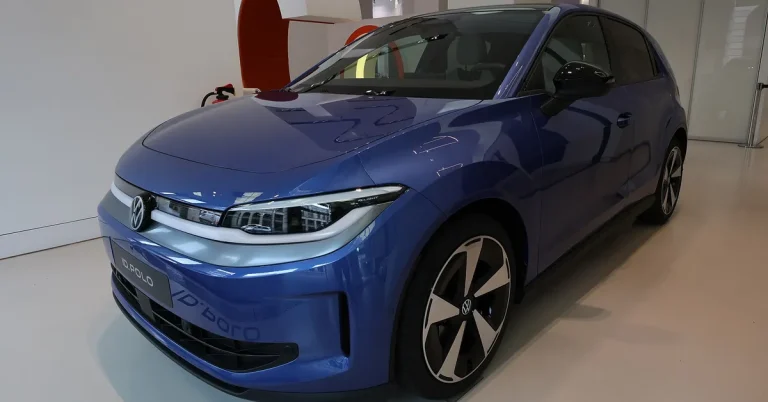
Volkswagen’s affordable electric-car family drew approximately 150,000 European orders through the end of September, before deliveries began. But German buyers of the entry-level ID. Polo reportedly face waits of up to 21 months.
ID. Polo orders pass 50,000
Demand for the four-model line-up was stronger than expected. A Volkswagen spokesperson described it as developing “significantly more dynamically than originally expected”. Production capacity and the pace of the manufacturing ramp-up could not be adjusted at short notice to match demand, the spokesperson said.
The VW ID. Polo accounted for more than 50,000 orders, with a German starting price of $27,298 (~AUD 41,190). Its waiting time earlier in 2026 was 10 months, before the longer reported delay for the base version.
Get the latest EV news first. Follow us on:
Other ID. Polo versions have shorter queues. The Sportline has a waiting time of about five months, while the GTI has a wait of about seven months.
The Skoda Epiq attracted more than 80,000 orders. In Germany, buyers reportedly face waits reaching 17 months for its most popular versions.
The Electric Urban Car Family also includes the Cupra Raval and VW ID. Cross. Attractive prices, modern electrical technology, everyday practicality and distinct brand identities have driven orders across the family.
Spanish factories prepare to lift output
The Martorell factory builds the Cupra Raval and VW ID. Polo on the same assembly line. Raval production experienced a multi-day halt at the plant.
Martorell currently runs two shifts and produces up to 1,000 vehicles a day. It plans to introduce a third shift, taking daily output to as many as 1,200 vehicles. More employees are also being added to the workforce.
A nearby battery-pack factory has capacity for up to 1,200 packs a day. Battery cells used at Martorell come from external suppliers, including Gotion, whose new Spanish cell factory is expected to become fully operational early next year.
Pamplona produces the Skoda Epiq and VW ID. Cross. They share an assembly line with the T-Cross and Taigo, which are more profitable than their battery-powered counterparts.
Investment in Spain’s EV transition totals $10.9B (~AUD 16.5B). SEAT and Cupra’s total investment in the transition is $3.3B (~AUD 4.9B), including $327.6M (~AUD 494.4M) for the battery-system assembly plant at Martorell.
Shared engineering and a growing EV order book
SEAT and Cupra led the small-car project within Volkswagen’s Brand Group Core. The four models were developed for Europe on Volkswagen’s MEB+ electric-car platform and have more than 80 percent identical components and technologies. They share front-wheel drive, electric-drive systems and batteries, along with technical work on efficiency and range.
Demand for the small cars came alongside broader growth in Volkswagen’s European battery-electric business. Battery-electric order intake in Europe rose 60 percent year on year in the third quarter.
Volkswagen’s European battery-electric order book doubled compared with the end of 2025. Battery-electric vehicles represented around 40 percent of its European order book.
Germany also recorded a new peak for electric vehicles in October, when EVs accounted for 37 percent of new registrations.
Why it matters
For buyers, a low purchase price can come with a lengthy wait for delivery. Waiting times vary substantially between versions, making availability part of the buying decision.
Volkswagen is adding staff and planning an extra production shift, but its stated limits on short-term adjustments mean output cannot immediately catch up with demand.
Key Specs
- European family orders through September: Approximately 150,000
- VW ID. Polo orders: More than 50,000
- VW ID. Polo starting price in Germany: $27,298 (~AUD 41,190)
- Martorell current vehicle output: Up to 1,000 vehicles a day
- Martorell planned vehicle output: Up to 1,200 vehicles a day
✎ Images and news sourced from: volkswagen-group.com, electrive.com, autobild.de, insideevs.com, ithome.com, volkswagen.de, volkswagen-newsroom.com, vw.com, wikimedia.org. Featured photo: Brewster239, CC BY-SA 4.0, via Wikimedia Commons.
