
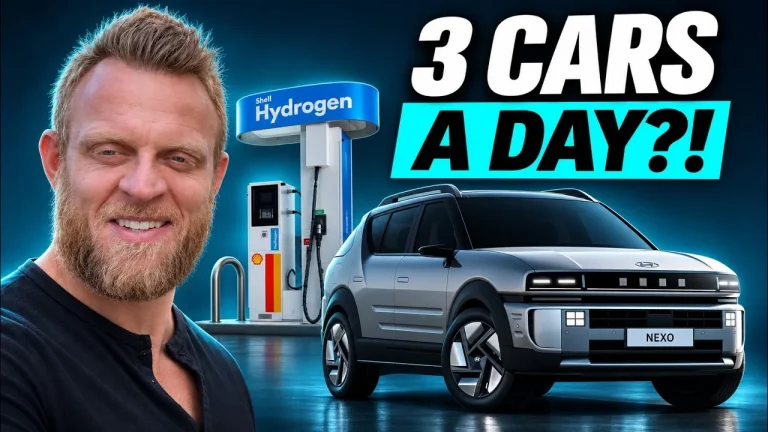
When I visited Hyundai Australia’s head office in Sydney to pick up an Ioniq 9 for a test drive, I was struck by the sight of their enormous hydrogen refueling station. But despite its size and cost—around A$2 million (~$1.33 million) to upgrade—the station’s capabilities reveal some major challenges for hydrogen as a fuel for passenger vehicles.
Hyundai’s Hydrogen Investment and Station Output
The hydrogen station at Hyundai’s Sydney headquarters produces hydrogen using solar power. At full capacity, it makes just 20 kilograms of hydrogen per day. Since the Hyundai Nexo, their newest hydrogen SUV, holds nearly seven kilograms per tank, this means the station can fill only about three vehicles a day from its solar output.
To put the investment in perspective, the station’s upgrade cost Hyundai about A$2 million (~$1.33 million). In comparison, a single fast EV charger—much smaller and cheaper—can top up dozens of electric cars daily for a fraction of that cost.
Get the latest EV news first. Follow us on:
Efficiency and Practical Challenges
Hydrogen vehicles do have some advantages: a Nexo can travel more than 800 kilometers (500 miles) on a full tank, and refueling takes about five minutes—if you can find a station. Australia’s abundant sun and wind could, in theory, provide the renewable energy needed to produce hydrogen locally.
However, the process of making hydrogen from solar power, compressing it, and then converting it back to electricity inside the car is highly inefficient. Electric vehicles go roughly three times as far on the same amount of solar power. This dramatic drop in efficiency is a major reason why hydrogen for passenger cars keeps stalling.
Infrastructure and Market Realities
The infrastructure for hydrogen cars in Australia is minimal. Hyundai’s own count is just nine hydrogen stations nationwide. There are only about 35 Hyundai Nexos in the entire country, and not one has been sold to the public. The new Nexo model, promised for 2026, hasn’t arrived—mainly because there’s really no way for people to refuel them.
Hyundai Australia itself admits that hydrogen costs more than electric, and says the hardest part will be finding customers. Overseas, the situation is similar: Shell has closed its hydrogen stations in California, and Austria’s hydrogen stations have also shut down.
Hyundai’s Future: Electric or Hydrogen?
Despite some Hyundai executives in Korea still believing in hydrogen’s long-term potential, the company is clearly aware of the challenges. Even as they consider bringing a new hydrogen car to Australia, they acknowledge that the hardest part will be finding customers.
Meanwhile, Hyundai is already succeeding with electric vehicles. The Ioniq 9 I drove from Sydney to Melbourne and back is a testament to their electric lineup.
What This Means for Hydrogen Cars
I think the economics just don’t stack up for hydrogen passenger vehicles right now. With such high costs, low efficiency, and almost no infrastructure, it’s clear why hydrogen keeps stalling. Even Hyundai, after investing heavily, is struggling to make hydrogen work for everyday drivers.
