
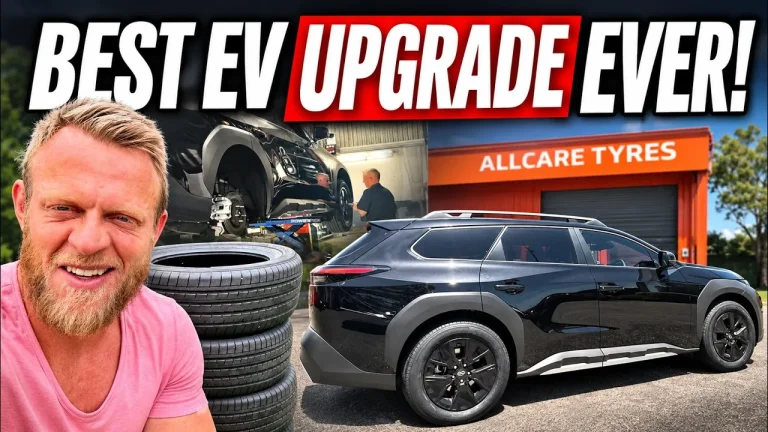
After owning my Subaru Trailseeker for just under a month, I decided to make what I think is the single biggest upgrade you can make to any car: swapping out the original tyres. The Trailseeker came from the factory with Yokohama Advan V61 E+ tyres, but I replaced them with a set of Hankook iON evo AS tyres. These were fitted by the team at Allcare Tyres in Doyalson, and I want to share exactly why I made this change and what my first impressions have been.
Why I Chose EV-Specific Tyres
Hankook claims their iON range is the world’s first tyre line developed exclusively for electric vehicles. That’s important because electric motors deliver torque instantly, which puts unique demands on tyres compared to internal combustion cars. I wanted to see if these EV-specific tyres would really make a difference on my Trailseeker, especially since I’ve already taken it on moderate off-road tracks and found it performs better off-road than the petrol Subaru Outback on the same course.
The plan was to fit the new tyres, then test them both on-road and off-road, including sand driving. I was genuinely curious to see how much of a difference they would make, not just in terms of performance but also in comfort and practicality.
Get the latest EV news first. Follow us on:
The Fitting Process and First Impressions
The team at Allcare Tyres swapped out the Yokohamas for the Hankook iON evo AS tyres right outside the shop. One of the first things I noticed was the difference in sidewall stiffness. With the tyres off the car, it was obvious: the original tyres would collapse when you pressed on them, but the Hankooks stayed stiff. The sidewalls felt much thicker, and even the tread patterns were totally different.
During the fitting, I learned a bit about tyre balancing and sensors. The wheels were balanced to zero out vibration, and the tyre pressure was set at probably 40 psi. There was also some discussion about sensor locations, especially compared to older Rolls-Royce and Tesla wheels, which can be tricky to fit with their center caps.
Driving Experience: Ride, Comfort, and Handling
With the new Hankooks fitted, I immediately noticed the stiffer sidewalls. Normally, I would expect a stiffer tyre to mean a harsher ride, but to my surprise, comfort felt exactly the same. After driving about 40 kilometers, I thought the tyres were quieter and maybe even slightly more comfortable, but the difference in comfort was so small I couldn’t really tell. If anyone can notice a difference, I’d be amazed.
After putting about 200 kilometers on the new tyres, my main takeaway is a big improvement in cornering. That’s the most noticeable change so far.
Tyre Longevity and the Hankook Tread Guarantee
One of the big concerns people have with EVs is tyre wear. There’s a common belief that electric cars chew through tyres faster, and that can be true if you drive in a certain way. However, Hankook backs the iON evo AS tyres with a 70,000 kilometer tread guarantee in Australia. That’s about one and three-quarter laps around the planet. In the US, the same tyre comes with a 50,000 mile warranty, which is roughly 75,000 kilometers.
There is some fine print: in Australia, you need to buy a set of four tyres and get a wheel alignment from a Hankook dealer. You also have to get them checked every 10,000 kilometers or six months. If they wear out early, you get credit back.
What’s Next: Range, Wear, and Final Thoughts
I haven’t driven enough yet to comment on how these tyres affect range or long-term wear. My plan is to drive them for two or three thousand kilometers, including more off-road and sand driving, and then report back on how they perform in terms of range, noise, and tread life. Based on my experience so far, I think the tyres might even improve range, but I’ll need more data to be sure.
Ultimately, I’ve always believed that a set of tyres is the single biggest upgrade you can make to any electric car. If your EV comes with average or below average tyres, it’s worth considering an upgrade—I think so, anyway. For now, I’m happy with the Hankook iON evo AS tyres and look forward to seeing how they perform over the long haul.
