
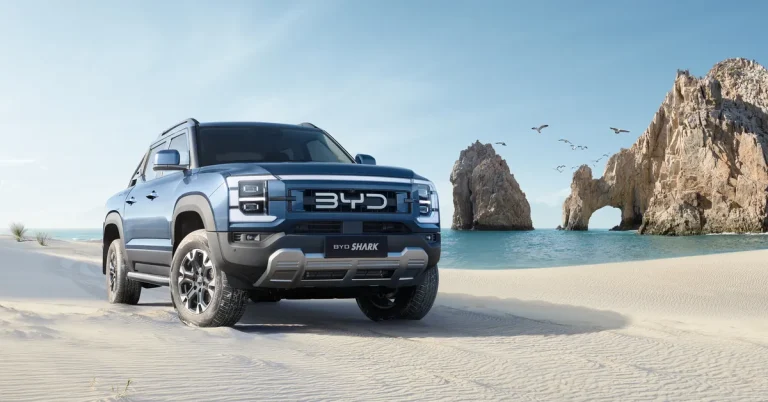
December 2 is set as the China launch date for BYD’s Fang Cheng Bao Shark pickup. It combines plug-in hybrid driving with towing and power for external devices.
China launch follows overseas rollout
Ahead of its launch, the Shark is expected to appear before the Chinese public for the first time on November 27 at the Guangzhou Auto Show. Its regulatory filing with the Ministry of Industry and Information Technology in China is complete.
The launch would bring the overseas Shark 6 to the brand’s domestic lineup. The five-seat, double-cab pickup combines a 320 kW powertrain with a 2500 kg maximum towing capacity.
Get the latest EV news first. Follow us on:
Mexico was the first overseas market to receive the Shark in May 2024, with Brazil and Australia among the other international markets it subsequently entered. That version offers about 100 km of pure electric range and about 840 km of combined range. With a low battery, its consumption is about 7.5 litres per 100 km; acceleration from 0–100 km per hour takes 5.7 seconds.
Turbo engine and two electric motors
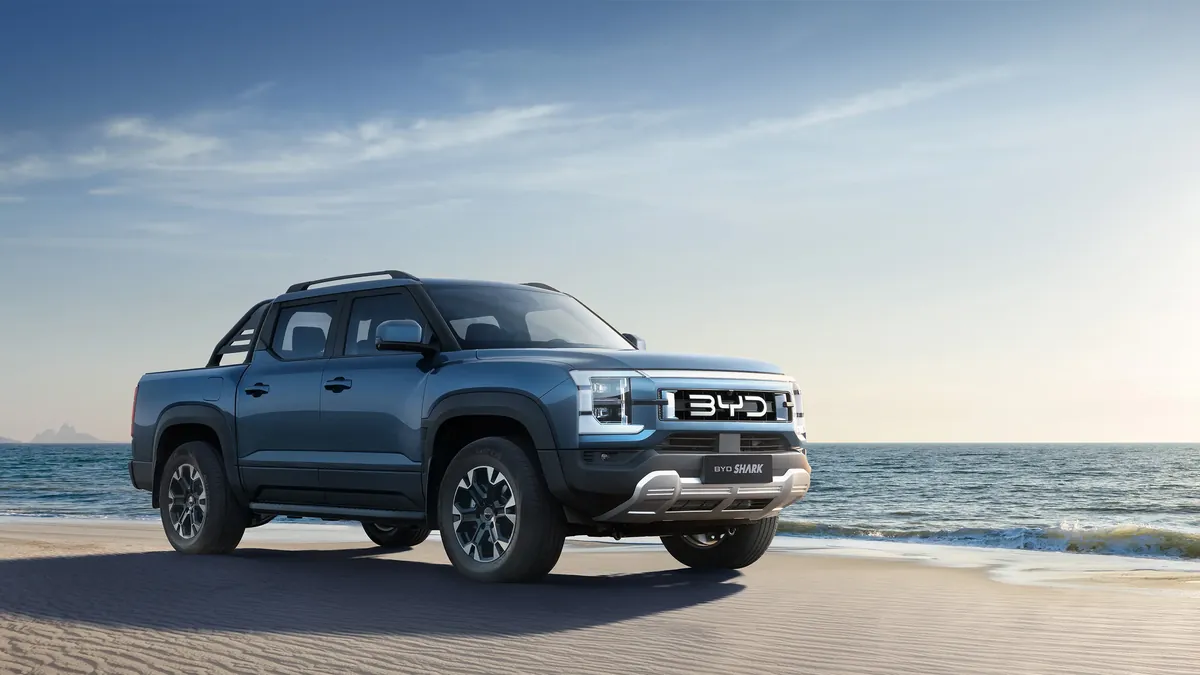
The Chinese Shark uses a 1.5-litre turbocharged plug-in hybrid powertrain built on BYD’s hybrid platform for off-road vehicles. It has a lithium iron phosphate battery, with electric motors driving the front and rear axles.
The front motor has a peak output of 170 kW, while the rear motor peaks at 150 kW. The petrol engine’s maximum power is 143 kW, with maximum net power rated at 135 kW. Top speed is 180 km per hour.
The Shark can also supply electricity to external devices through an outlet, providing power for equipment away from a fixed electricity supply.
Body-on-frame construction and towing
The Shark uses body-on-frame construction, with its body mounted on a separate ladder frame. It measures 5,457 mm (~214.8 inches) long, 1,971 mm (~77.6 inches) wide and 1,925 mm (~75.8 inches) tall, with a 3,260 mm (~128.3 inches) wheelbase.
Its curb weight is 2710 kg, and its rated load capacity is 460 kg. An optional trailer hitch supports uses including towing campers and carrying bicycle racks and motorcycle carriers.
The approach angle is 31 degrees. At the rear, the departure angle is 20 degrees with the tow hook fitted and 22 degrees without it. A metal skid plate sits beneath the front bumper.
Large displays and physical controls
Inside, a 15.6-inch central touchscreen runs BYD’s DiLink infotainment system. The digital instrument cluster measures 10.2 inches, while a windshield head-up display provides another way to view driving information.
Equipment includes intelligent voice control, a digital key using near-field communication and a 540-degree panoramic camera system. The cabin retains many physical buttons rather than placing every control on the touchscreen.
The centre console has mechanical buttons alongside large side handles. The cabin’s design follows the Bao 5, also known as the Denza B5, and uses the same four-spoke steering-wheel layout.

Why it matters
The planned China arrival would give more buyers access to the Shark. For drivers combining passenger transport with towing and equipment use, it brings those jobs together in a plug-in hybrid rather than a purely battery-electric vehicle. Physical controls also give drivers an alternative to using the central display for every interaction.
Key Specs
- Combined system power: 320 kW
- Maximum towing capacity: 2500 kg
- Rated load capacity: 460 kg
- Length: 5,457 mm (~214.8 inches)
- Wheelbase: 3,260 mm (~128.3 inches)
- Top speed: 180 km per hour
- Central touchscreen: 15.6 inches
✎ Images and news sourced from: cnevpost.com, yiche.com, carnewschina.com, techweb.com.cn, d1ev.com, tuningblog.eu, news18a.com.
