
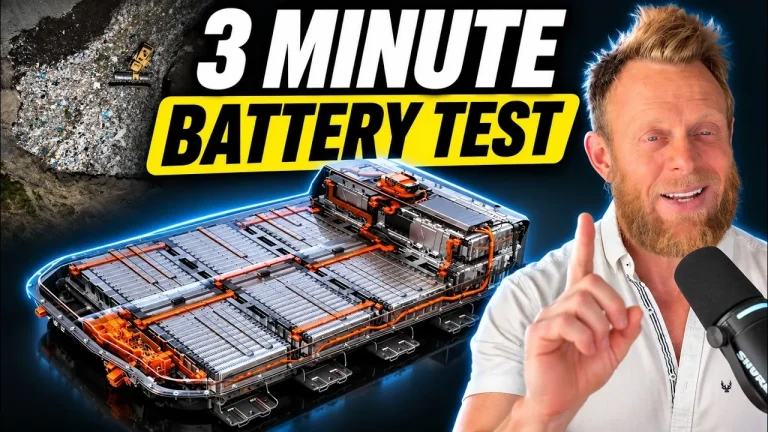
A team at the University of New South Wales has developed a prototype that can assess the health of electric vehicle (EV) battery cells in under three minutes, with lab accuracy above 90 percent. The prototype targets a major challenge in battery recycling and reuse, where uncertainty about battery condition leads to unnecessary waste and higher costs.
Why Most Retired EV Batteries Aren’t Dead
Sam Evans explains that when an EV battery is retired from a car, it usually still retains about 70 to 80 percent of its original energy capacity. In practical terms, that’s as much storage as three or four Tesla Powerwalls. Despite this, most homes aren’t powered by old car batteries because recyclers can’t easily identify which batteries are still usable.
Get the latest EV news first. Follow us on:
The Current Testing Problem
Today, evaluating an EV battery’s health requires fully charging and discharging it—a process that takes around 10 hours per battery. The cost for this is about A$120 (~$85.07) per battery. This lengthy and expensive process can also risk overheating if the battery is damaged. As a result, many batteries that could still be reused end up being shredded instead.
The UNSW Prototype: Fast, Accurate, and Versatile
The UNSW prototype offers a much faster solution, testing each cell in a battery pack with short pulses of electricity. Software then analyzes the cell’s response to determine its health. In laboratory trials, the system has achieved over 90 percent accuracy. The goal is to reduce the testing cost to below A$25 (~$16.68) per car battery.
This method works on the main types of EV batteries in use today, including lithium iron phosphate (LFP) and nickel-based (NMC) batteries. Since recyclers never know what battery chemistry they will receive, versatility is key.
Next Steps and Industry Impact
Sam notes that the technology is still at the prototype stage. The next phase involves trials on more than 500 real-world batteries, followed by pilot programs in recycling plants and storage systems built from used EV batteries. Good batteries could be reused for solar energy storage—Sam points out that Nissan LEAF batteries are already powering Rome’s airport—while worn-out ones can be recycled for valuable materials, recovering up to 90 percent of their contents as ‘black mass.’
What This Means for EV Owners and the Industry
Sam believes that a fast, accurate test could help preserve the value of EV batteries long after a car’s life ends.
