
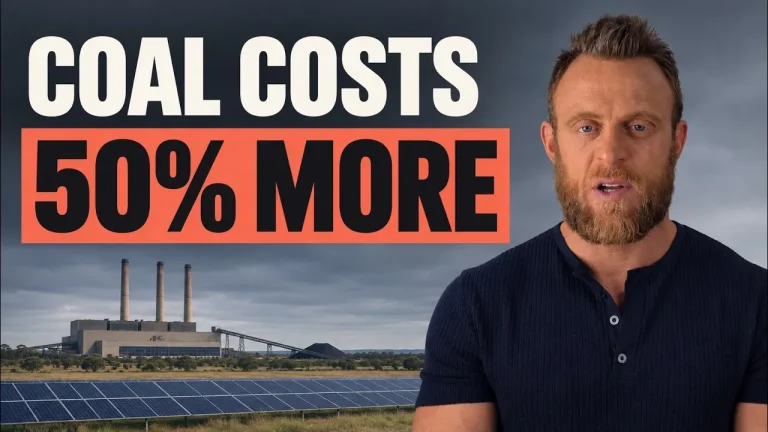
A new study from Griffith University in Australia has found that electricity generation would cost 30 to 50 percent more today if all new power stations over the past 20 years had been limited to coal and gas, rather than renewables. The research, also published through Cambridge in the UK, used Queensland as a test case and examined Australia’s main power grid.
What the Study Tested
The study’s authors, two energy economists, set out to answer a simple but rarely asked question: what would power cost today if no renewables had been built? They modelled a scenario where, for the past 20 years, every new power station added to the grid had to be coal or gas—no wind or solar farms allowed.
The result was clear. According to the study, making electricity under this scenario would cost 30 to 50 percent more than it does today. Sam Evans notes that this finding challenges the common claim that renewables are to blame for rising power bills.
Get the latest EV news first. Follow us on:
Why Old Assumptions No Longer Apply
Sam points out that, two decades ago, coal and gas were the cheapest ways to generate electricity. Many people still remember that era and believe it remains true. However, the situation has changed: most coal plants are now old, and building a new one is extremely expensive. Meanwhile, gas prices have surged globally, especially after Russia’s invasion of Ukraine.
Sam says the idea of returning to cheap coal power is a fantasy, as those low costs no longer exist. He also highlights that, while Australian household power prices rose by about one third between 2021 and 2024, wholesale power prices in the UK and Europe jumped by 200 to 400 percent over the same period.
Renewables’ Growing Role in Australia
South Australia has shifted dramatically towards renewables, moving from less than one fifth of its electricity from renewables in 2010 to about 75 percent today, mostly from wind and solar. At one point, big batteries supplied 40 percent of the state’s evening power—more than California’s best performance. Tasmania now runs almost entirely on renewables.
Queensland provides a surprising example. Despite the state government scrapping its renewable energy target, Queensland’s renewable share is now just ahead of New South Wales, with both states at around 40 percent.
Investment Driven by Economics, Not Policy
Sam notes that even where politicians have tried to slow renewable development, investment hasn’t stopped. Since 2019, investors have approved more than 100 renewable projects in Australia, mostly as straightforward commercial deals. The reason is simple: renewables are the cheapest option to build.
What This Means for Power Prices
Sam argues that if someone claims renewables are making power expensive, it’s important to ask, “Compared to what?” The Griffith University study tested the alternative, and found it would cost up to 50 percent more.
