
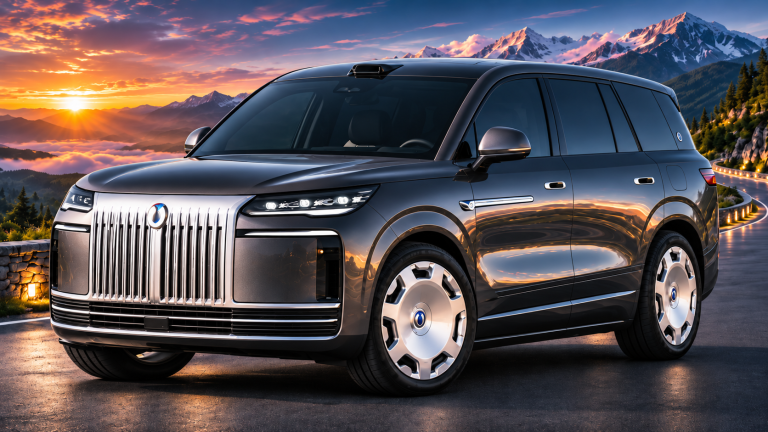
BYD’s updated Denza N9 SUV has revised styling, while a Chinese regulatory filing details a fully electric version. Buyers get a look at its electric drivetrain, but battery capacity, range and charging details remain undisclosed.
New styling for the flagship SUV
The updated N9 has semi-hidden, flush door handles and two slim tiers of elongated taillights. Its front bumper adopts a mock grille and a large air intake.
The front-end design resembles the Zeekr 9X and Voyah Taishan, with large nose panels and vertical slats. Unofficial facelift renderings by Sugar Design were released on November 23.
Get the latest EV news first. Follow us on:
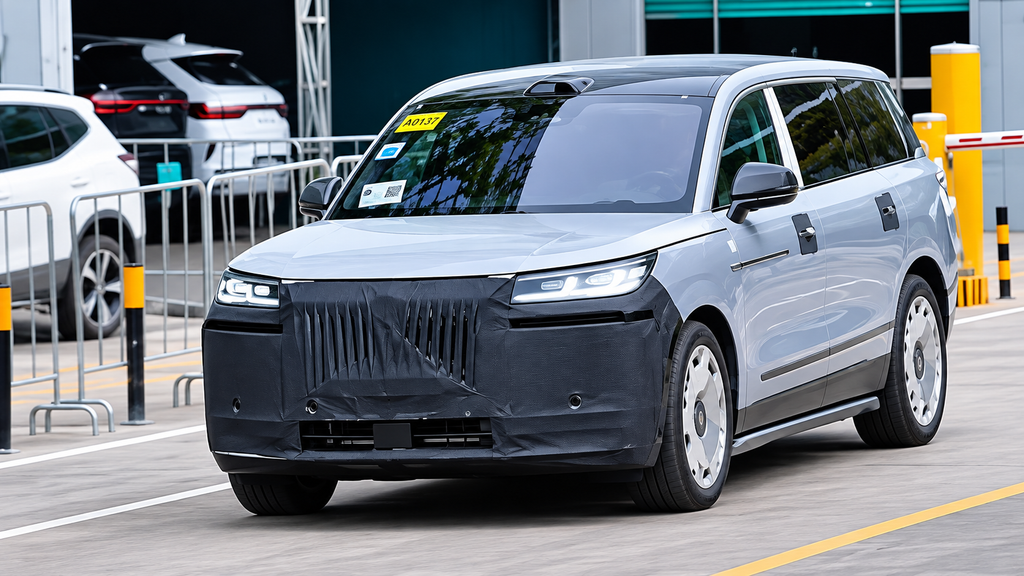
The fully electric N9 has a closed front grille. BYD applied for a sales licence for that version in early November.
The electric version appeared in batch 413 of the Ministry of Industry and Information Technology’s product announcements. The ministry published the notice on November 4, with a public comment period running through November 10.
Three motors deliver 890 kW
The electric N9 uses three motors to provide all-wheel drive and 890 kW of total peak power. Its independent-drive platform is called e3, also known as YiSanFang.
The front motor produces peak power of 270 kW. Each of the two rear motors produces 310 kW.
The filing lists a top speed of 240 km per hour. Kerb weights are 3105 kg and 3180 kg, putting both versions above three tonnes.
Brake-system entries include FinDreams brake-by-wire or Bosch electronic stability control. An event data recorder is also fitted.
Five or six seats in a large SUV
The electric N9 filing lists both five-seat and six-seat configurations. The SUV measures 5270 mm (~207.5 inches) long, 2030 mm (~79.9 inches) wide and 1830 mm (~72 inches) high, with a wheelbase of 3125 mm (~123 inches).
A roof-mounted lidar sensor remains part of the exterior specification. The electric N9’s driving-assistance system is listed as DiPilot 5.0, also called TianShenZhiYan 5.0.
Standard equipment for the electric version includes a panoramic sunroof and electrically operated side steps.
The plug-in hybrid came first
At its initial launch in March 2025, the N9 was a plug-in hybrid powered by a 152 kW turbocharged 2.0-litre engine. It has 680 kW of combined power and a 75.2 kWh battery.
Its range ratings are 420 km under China’s CLTC test and 344 km under WLTP. The standard cabin has six seats in a two-by-two-by-two arrangement, and prices range from $61,335 (~AUD 92,433)–$70,315 (~AUD 105,966).
The plug-in hybrid has Flash Charging technology. Its Flash Charge Edition launched on May 18.
Why it matters
The two seating layouts give families following the electric N9 a choice to consider. But without battery capacity, driving range or charging capabilities in the filings, buyers still lack key figures for comparing it with other battery-powered family SUVs.
Key Specs
- Total peak power: 890 kW
- Top speed: 240 km per hour
- Length: 5270 mm (~207.5 inches)
- Width: 2030 mm (~79.9 inches)
- Height: 1830 mm (~72 inches)
- Wheelbase: 3125 mm (~123 inches)
- Kerb weight: 3105 kg or 3180 kg
✎ Images and news sourced from: miit-eidc.org.cn, tuningblog.eu, 9carthai.com, cqn.com.cn, whichcar.com.au, smzdm.com, carnewschina.com, ithome.com, 12365auto.com.
