
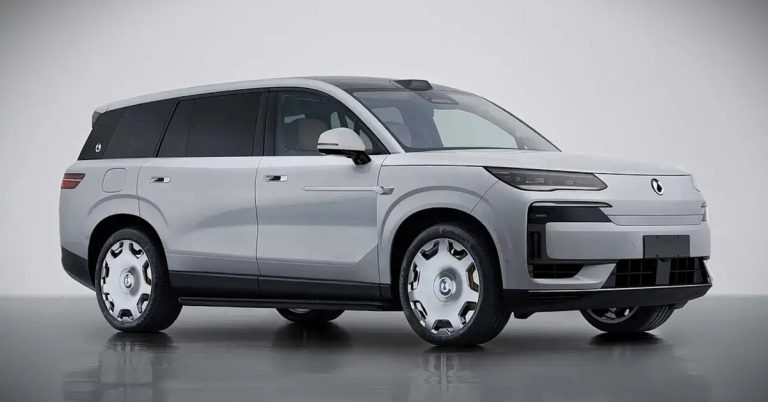
China’s Ministry of Industry and Information Technology has published regulatory filings for the all-electric Denza N9, revealing a tri-motor setup delivering 1,194 horsepower and a curb weight exceeding 3,100 kg. The Denza N9 EV is positioned to compete in China’s premium full-size SUV segment, targeting rivals like the Aito M9 and Li Auto Li L9.
Tri-Motor Powertrain and Performance
The Denza N9 EV features three permanent magnet synchronous motors: a 270 kW front motor and two 310 kW rear motors, for a combined peak output of 890 kW (1,194 hp). The system delivers all-wheel drive and is associated with BYD’s e3 (Yisanfang) architecture, also seen in the Denza Z9 GT.
The N9 EV is listed with a maximum speed of 240 km/h. The regulatory filing covers two variants, QCJ6530ABBEV1 and QCJ6530ABBEV2, which differ in their braking systems—one using FinDreams’ integrated power brake system and the other equipped with Bosch BWA and ESP hardware supplied by Bosch Automotive Products (Suzhou) Co., Ltd.
Dimensions, Weight, and Features
The Denza N9 EV measures 5,270 mm (~207 inches) in length, 2,030 mm (~80 inches) in width, and 1,830 mm (~72 inches) in height, with a 3,125 mm (~123 inches) wheelbase. Certified curb weights are 3,105 kg (~6,846 lbs) and 3,180 kg (~7,010 lbs), with a gross vehicle weight of 3,760 kg (~8,289 lbs).
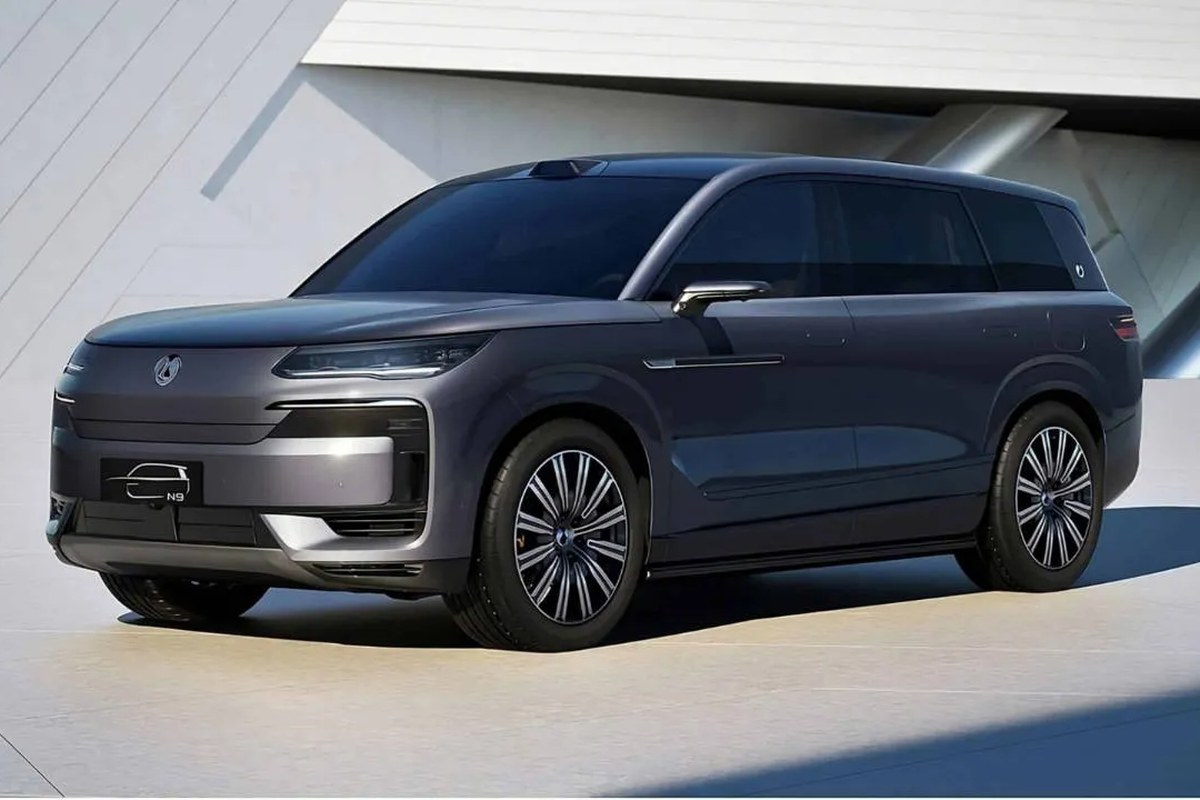
Design highlights include a closed front fascia, roof-mounted LiDAR, and side cameras. Optional features listed in the filing are 22-inch forged wheels, five- and six-seat configurations, two-tone paint, and black exterior trim. The battery uses LFP cells supplied by Guangxi ASEAN FinDreams Battery Co., Ltd., with pack assembly by Shenzhen BYD Auto Industry Co., Ltd.
Market Positioning and Platform
The Denza N9 EV is set to enter China’s premium full-size SUV segment, competing with both battery-electric and plug-in hybrid flagships. It combines independent three-motor drive with a separate rear-wheel steering system, though the filing does not confirm which advanced platform functions will be available in the production model.
While the N9 EV’s battery capacity, range, and charging specifications remain undisclosed, the model shares its LFP battery chemistry with the updated Denza N9 PHEV.
Competitor Comparison
Key competitors in the segment include the Li Auto Li L9, priced at $61,482 (~AUD 87,790), and the Aito M9, starting at $70,483 (~AUD 100,643). The Aito M9 offers a 120 kWh ternary lithium battery and a 497 kW dual-motor AWD system, while the Denza N9 EV delivers higher peak power with its tri-motor setup and LFP battery chemistry.
The Mercedes-Benz GLS is also a notable rival, representing established European luxury in this segment. Additionally, the Zeekr 9X PHEV, built on Geely’s SEA-S architecture, offers up to 1,030 kW (1,381 hp) with a 2.0-litre turbocharged engine, further intensifying competition among high-output SUVs.
Historical Context
BYD’s sales growth slowed to 7.73% in 2025, marking its weakest performance in five years. The company delivered 4.6 million vehicles in 2025, a 10% year-on-year decline. Despite this, BYD maintained a strong domestic presence, holding approximately 56% market share in China during the first half of 2026.
Why this matters
The Denza N9 EV’s entry into the premium full-size SUV market underscores BYD’s commitment to high-performance electric vehicles and advanced technology. With a tri-motor setup and substantial curb weight, the N9 EV aims to set new benchmarks for power and capability in its class.
This launch comes at a time when BYD is seeking to reinforce its leadership in China’s EV market, even as overall sales growth has slowed and competition intensifies among both domestic and international brands.
What this means for buyers
Buyers considering a premium electric SUV in China will soon have another high-powered option with the Denza N9 EV. Those comparing models should weigh the N9’s tri-motor performance and LFP battery chemistry against competitors like the Aito M9 and Li Auto Li L9, as well as established luxury offerings from Mercedes-Benz.
With battery capacity and range details yet to be disclosed, potential buyers may wish to wait for further announcements before making a final decision.
Key Specs
- Peak Power Output: 890 kW (1,194 hp)
- Motor Configuration: Tri-motor AWD (front: 270 kW, rear: 2 x 310 kW)
- Maximum Speed: 240 km/h
- Dimensions (L x W x H): 5,270 mm x 2,030 mm x 1,830 mm (~207 x 80 x 72 inches)
- Wheelbase: 3,125 mm (~123 inches)
- Curb Weight: 3,105–3,180 kg (~6,846–7,010 lbs)
- Gross Vehicle Weight: 3,760 kg (~8,289 lbs)
- Battery Chemistry: LFP (supplied by Guangxi ASEAN FinDreams Battery Co., Ltd.)
Images sourced from: carnewschina.com, dubicars.com

