
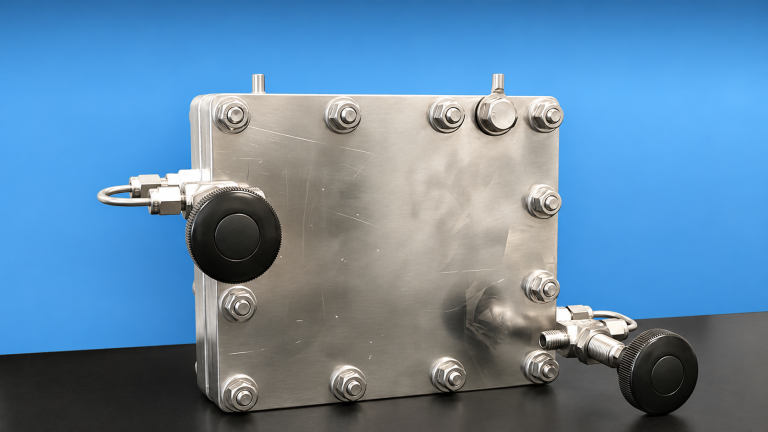
CATL is investigating lithium-air battery technology, a chemistry that has generated interest for its high theoretical energy density. While some reports suggest the potential for electric vehicle ranges up to 2,000 km, CATL has not announced any production targets or commercial timelines for this technology.
CATL’s Approach to Lithium-Air Batteries
At the 2026 Equipment Powerhouse Forum, CATL Chief Scientist Wu Kai identified lithium-air technology as a long-term research direction for the company. According to CATL’s broader battery roadmap, sodium-ion and all-solid-state batteries are positioned closer to commercialisation, while lithium-air remains a more distant prospect.
CATL has not announced a 2,000 km production-car target or a commercial launch schedule for lithium-air battery technology.
How Lithium-Air Batteries Work
Unlike conventional lithium-ion batteries, which store lithium within two electrodes, lithium-air batteries use metallic lithium as the negative electrode and oxygen from the environment as the positive reactant. During discharge, lithium reacts with oxygen to form lithium peroxide inside a porous cathode. Charging reverses this reaction, releasing oxygen and returning lithium ions to the anode.
The frequently cited theoretical specific energy for lithium-air batteries is around 3,505 Wh/kg. However, this figure describes electrochemical potential, not the performance of a complete automotive battery. Additional components such as electrolytes, electrodes, protective materials, and air-management equipment add weight and volume, reducing practical energy density.
Laboratory Progress and Ongoing Challenges
Automotive interest in lithium-air batteries is not new. IBM’s Battery 500 project, launched in 2009, aimed to develop a metal-air battery for 805 km (500 miles) of range but did not result in a commercial product.
Recent research has made progress in understanding and improving lithium-air batteries. A 2025 study by the University of Science and Technology of China examined how electrolyte oxygen-transport properties affect reaction mechanisms. In 2024, researchers from Jilin University and the Chinese Academy of Sciences reported a lithium-air pouch-cell achieving 757.5 Wh/kg and 241 cycles under laboratory conditions. Another approach from the Illinois Institute of Technology and Argonne National Laboratory used a solid-state lithium-air architecture, completing at least 1,000 cycles at room temperature with a theoretical energy-density potential of 1,200 Wh/kg.
Despite these advances, none of the laboratory results establishes a production-ready passenger-car battery. Engineering challenges remain, including oxygen management, chemical stability, rechargeability, and the integration of supporting equipment.
Key Engineering Roadblocks
Lithium-air batteries require controlled air intake and filtration to prevent moisture and carbon dioxide from degrading the battery. Supporting equipment for air management adds weight and complexity. For example, a 2023 study in the Journal of Energy Storage estimated that such equipment would consume 5.4% of battery power in a proposed vehicle configuration.
Other challenges include removing lithium peroxide from the cathode during charging, which can generate reactive oxygen species that attack cell components and reduce cycle life. Lithium-metal anodes also face instability during repeated use. Lower round-trip efficiency and increased thermal-management demands further complicate automotive applications.
Specific energy, volumetric energy density, and power density are all important for vehicle performance. High specific energy alone does not guarantee a practical or reliable battery for passenger cars.
Why this matters
CATL’s exploration of lithium-air battery technology highlights ongoing efforts to push the boundaries of energy storage for electric vehicles. While the chemistry offers high theoretical energy density, significant engineering and practical challenges must be overcome before it can be considered for commercial automotive use.
Current research demonstrates progress but also underscores the gap between laboratory achievements and real-world, production-ready solutions.
Key Specs
- Theoretical Specific Energy: 3,505 Wh/kg
- Laboratory Cell Energy Density (2024 study): 757.5 Wh/kg
- Laboratory Cycle Life (2024 study): 241 cycles under specified conditions
- Solid-State Lithium-Air Architecture (Illinois Tech & Argonne): 1,000+ cycles at room temperature, 1,200 Wh/kg theoretical potential
- Supporting Equipment Power Consumption (2023 study): 5.4% of battery power in proposed vehicle configuration
Images sourced from: pbxscience.com

