
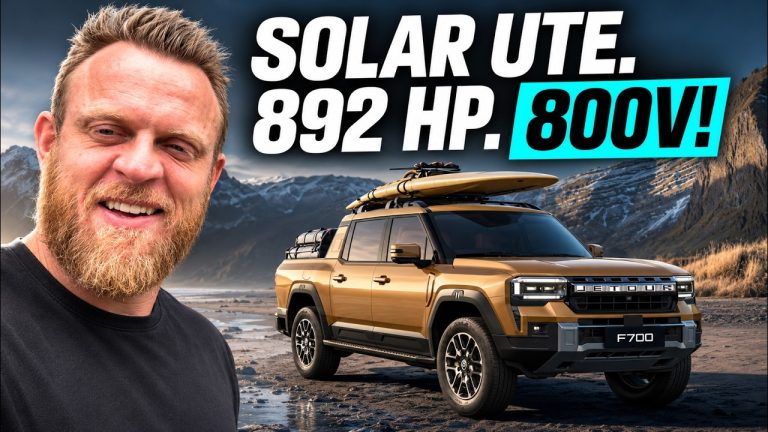
The Jetour F700 is a new plug-in hybrid ute that’s just been launched in China, surprising me with its combination of serious off-road ability, huge power, and innovative features like solar charging. With 892 horsepower, a 3.5-tonne towing capacity, and a starting price of $44,000 (~AUD 63,254), the F700 is targeting buyers who want both performance and practicality. It’s confirmed for Australia, the UAE, the Philippines, Mexico, and South Africa, with sales starting now in China and more markets to follow by 2027.
Real Off-Road Capability and Power
I expected the F700 to be more of a lifestyle ute, but it’s genuinely capable off-road. I drove it through deep mud, rutted climbs, loose rocks, and creek crossings—on standard Michelin 275/60 R20 road tires, not all-terrains. Aside from one tricky spot, it handled everything impressively. The two electric motors deliver instant torque to every wheel, and with locking front and rear differentials plus a center diff, it’s set up for serious terrain. It can also wade through up to 900 mm of water.
Low-speed control is the best I’ve ever felt in a ute, thanks to the electric motors’ precise power delivery. This is a big advantage for technical off-roading, especially when you’re relying on battery power for the sharpest response.
Performance, Battery, and Charging Specs
The F700 pairs a 2.0-liter turbo petrol engine with two electric motors for a combined output of 665 kW (892 hp)—more than double the power of a Ford Ranger Raptor, which makes 292 hp. The battery is a 34 kWh lithium iron phosphate pack from CATL, giving up to 150 km of electric range on China’s test cycle (likely closer to 100 km on Australia’s cycle). With a full tank and battery, Jetour claims a total range of 1,300 km.
It uses an 800V architecture, which is a big step up from current plug-in hybrid utes in Australia. Jetour says you can charge from 20% to 80% in just 10 minutes, or from 10% to 80% in about 12 minutes—much faster than any current rivals.
Size, Towing, and Utility
The F700 is a big truck: 5.5 meters long (216.54 inches), 2.05 meters wide (81.11 inches), 1.99 meters tall (78.35 inches), and with a 3.35-meter (131.9 inches) wheelbase. The bed is long and wide, making it more practical for tradies or anyone who needs to carry bulky gear. It tows 3.5 tonnes and has a 6.6 kW power outlet in the tray for running tools or camping gear.
Solar Charging and Interior Features
One standout option is the solar charging system—at least in China. You can add solar panels to the roof and bonnet, which together peak at 640 W and can generate up to 6 kWh on a sunny day. That’s about 25 km of free driving per day while the ute sits in the sun. There aren’t panels in or on the tray yet, but that could be a future option.
Inside, the F700 feels high quality and comfortable. There’s a wide rear seat suitable for three adults, Jamo speakers, a massive digital display reminiscent of BMW, and a spacious center console. The materials feel premium, with soft surfaces and solid-feeling doors. It’s a big step up from the typical ute interior, and I honestly think it looks nicer than some BMWs I’ve seen.
Pricing and Market Availability
In China, the Jetour F700 starts at $44,000 (~AUD 63,254) for the base model, with the top version at $50,000 (~AUD 71,880). It’s already on sale in China and available to order in the UAE, confirmed for the Philippines and Mexico, and will arrive in South Africa and Australia in 2027. There’s no word yet on launches in the US, Canada, or the UK.
What This Means for Buyers and the Market
I think the Jetour F700 sets a new benchmark for what a plug-in hybrid ute can be. With real off-road ability, huge power, fast charging, solar range, and a high-quality interior, it’s a unique combination that’s not matched by anything else on the market right now. For buyers, especially in Australia and other markets where it’s coming soon, this could be the most capable and versatile ute available—one that can even fuel itself from sunlight. I’ll be keeping a close eye on this one as it rolls out to more countries.

