
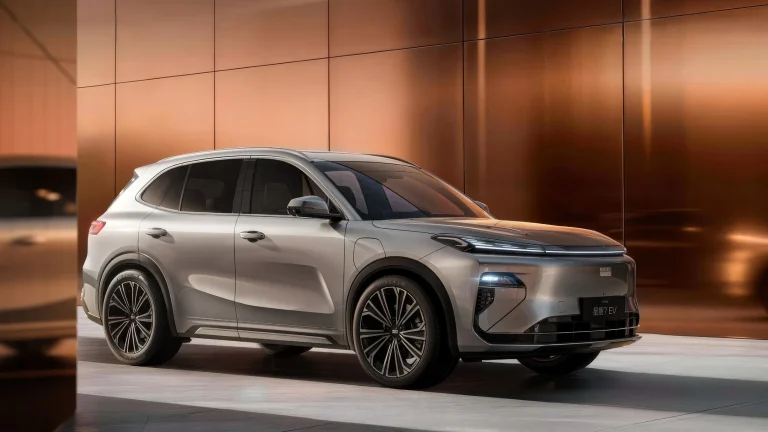
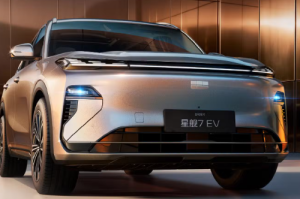
Geely Galaxy has officially revealed the Starship 7 EV, a battery-electric mid-size SUV that sits above the EX5 in the brand’s SUV hierarchy. The new model offers two CLTC range figures, 525 km and 605 km, uses a single front motor with up to 160 kW, and keeps the same GEA platform and core dimensions as the hybrid Starship 7 EM-i.
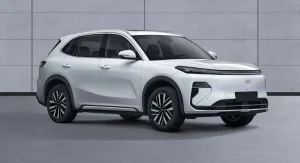
Geely Galaxy has introduced the Starship 7 EV, a fully electric version of its mid-size SUV line. The new model is offered with two CLTC range ratings, 525 km and 605 km, depending on battery choice, according to the company’s announcement.
The EV continues to use Geely’s GEA architecture, the same basic platform employed by the hybrid Starship 7 EM-i. In practice, that means Geely has kept the underlying body structure and packaging, while replacing the hybrid powertrain with a battery-electric setup.
Battery and powertrain details
Geely says the Starship 7 EV is available with either a 60.2 kWh pack or a larger 68.39 kWh battery. Both versions use a front-mounted single electric motor rated at 160 kW, with torque estimated at about 300 Nm.
The SUV uses a front-wheel-drive layout and is tuned for efficiency rather than performance. Of the two announced versions, the 605 km model is the longest-range specification currently disclosed.
Dimensions carry over from the hybrid model
The Starship 7 EV keeps the same size as the EM-i variant, measuring 4,740 mm long, 1,905 mm wide, and 1,685 mm tall, with a wheelbase of 2,755 mm. Geely lists the drag coefficient at 0.278 Cd, which suggests the body has been shaped to limit aerodynamic losses.
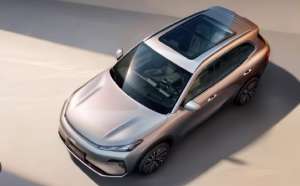
Those dimensions place it above the EX5, also known in China as the Geely Galaxy E5. The EX5 is shorter and slightly narrower, making the Starship 7 EV the larger of the two in Geely’s electric SUV lineup.
Design updates focus on EV identity
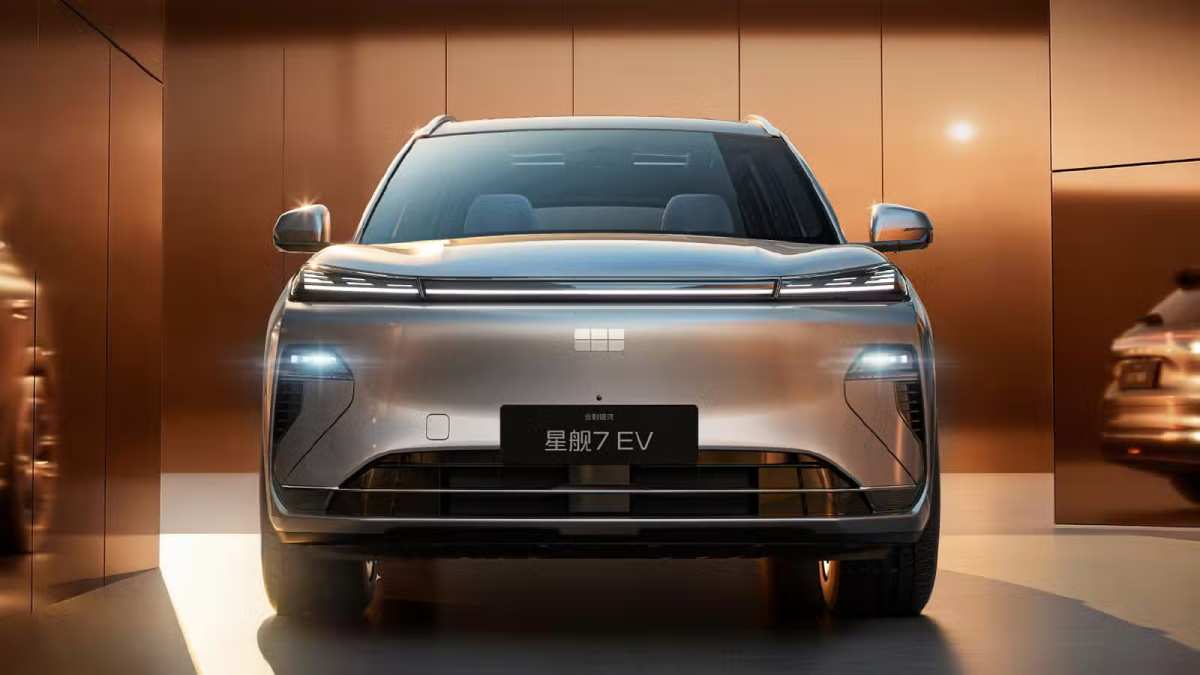
Visually, the electric version adopts a closed front end, a common change on battery-electric vehicles because it no longer needs the same level of airflow for engine cooling. Geely also fitted full-width daytime running lights and revised rear lighting to distinguish the EV from the hybrid version.
The model continues to offer 18-inch and 19-inch low-drag wheels. These wheel designs are aimed at improving efficiency, especially on the higher-range variants.
Interior and software
Inside, the Starship 7 EV uses Geely’s Flyme Auto infotainment system. The setup links the central screen and digital instrument cluster with a smartphone-style interface, reflecting Geely’s effort to standardize its in-car software across the Galaxy range.
That software strategy matters because Chinese automakers are increasingly competing not just on battery and motor specs, but on digital experience, interface design, and ecosystem integration.
How it compares with the EX5
Geely positions the Starship 7 EV above the EX5 in its global electric SUV portfolio. The EX5 is a compact SUV at 4,615 mm in length, 1,901 mm in width, and 1,670 mm in height, with a 2,750 mm wheelbase.
The EX5 is commonly fitted with a 60.2 kWh LFP battery and a 160 kW motor, with range figures of around 413 km CLTC depending on market and configuration. It is also marketed as Geely’s entry-level global EV SUV and has already been sent to several overseas markets.
By comparison, the Starship 7 EV is larger, offers more range, and is aimed at buyers who want a roomier SUV with stronger long-distance capability. Both vehicles use similar motor output and share the GEA platform, but they are clearly positioned for different roles.
Market context and pricing
Geely has not yet announced pricing for the Starship 7 EV. For reference, the hybrid Starship 7 EM-i launched in China at 95,800 to 123,800 yuan, or roughly 14,000 to 18,100 USD.
Sales data for the EM-i version show volatile monthly performance, according to China EV DataTracker. Reported domestic deliveries were 12,001 units in November 2025, 5,190 in December, 3,309 in January 2026, 3,295 in February, and 3,779 in March 2026.
Geely has also been expanding the Starship 7 platform into overseas production, including assembly in Indonesia for export markets. In some regions, the model is sold under the Geely Starray EM-i name, showing how the company is adapting branding for different markets.
The Starship 7 EV adds another layer to that strategy. It gives Geely a larger electric SUV with more range than the EX5, while keeping the same basic platform family and software approach.
Why This Matters
The Starship 7 EV shows how Geely is separating its SUV lineup into clearer tiers rather than relying on one all-purpose electric model. For buyers, that means a wider choice between an entry-level global EV SUV like the EX5 and a larger, longer-range alternative for family use or highway driving.
It also highlights a broader trend in China’s EV market: manufacturers are reusing platforms across hybrid and electric versions while changing battery size, range, and software to target different customer needs. That helps reduce development costs, but it also makes model positioning and naming more important than ever.
For overseas markets, the launch may matter because Geely is continuing to build export-ready vehicles that can be adapted for different regions under different names. That makes the Starship 7 EV relevant not only as a domestic China launch, but also as part of Geely’s global electric SUV expansion.
Key Specs
- Model: Geely Galaxy Starship 7 EV
- Powertrain: Single front electric motor
- Motor output: 160 kW
- Estimated torque: Around 300 Nm
- Battery options: 60.2 kWh or 68.39 kWh
- Range: 525 km or 605 km CLTC
- Layout: Front-wheel drive
- Platform: Geely GEA architecture
- Length: 4,740 mm
- Width: 1,905 mm
- Height: 1,685 mm
- Wheelbase: 2,755 mm
- Drag coefficient: 0.278 Cd
- Wheel sizes: 18-inch and 19-inch
- Infotainment: Flyme Auto
Source: CarNewsChina

