
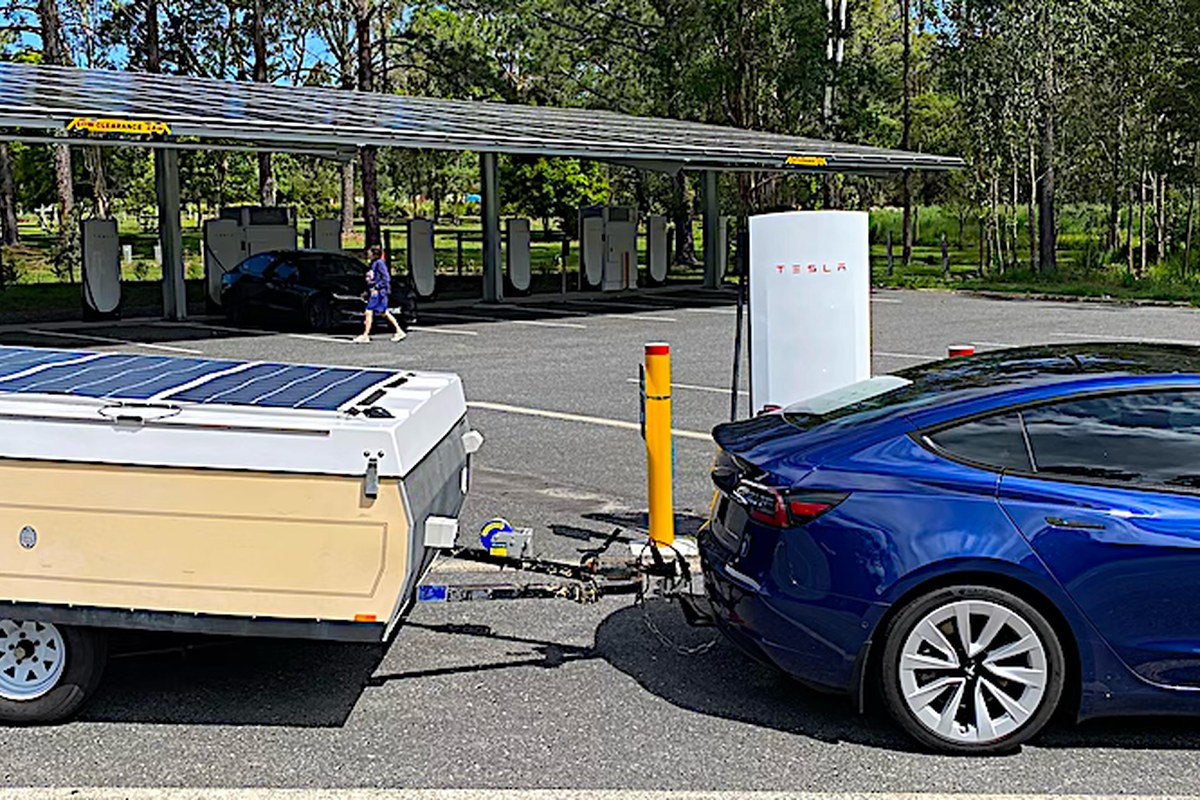
Towing a classic pop-top camper with an electric vehicle is a real-world test of range, charging infrastructure, and practicality. TheDriven reports on a 33-day, 5,693 km (~3,538 miles) journey from Brisbane to Melbourne and back, using a 5-year-old Tesla Model 3 and a 50-year-old Cub Drifter camper.
A Modern EV Meets a Classic Camper
The journey paired a 5-year-old Tesla Model 3 with a 730 kg (~1,610 lbs) Cub Drifter pop-top camper, loaded with essentials. The camper, despite its age, was equipped with a 3 kWh Powertech battery pack charged by 600W rooftop solar panels or mains power. This setup powered a 30L fridge and 22L freezer, enabling up to three days off-grid living with adequate sunshine.
No gas was used, and aside from tail-lights, there was no power connection between the car and camper. The trip did not utilize vehicle-to-load features, but the solar system allowed for extended off-grid capability, limited mainly by water supply.
Route, Charging, and Real-World Efficiency
The 33-day route covered 5,693 km (~3,538 miles), starting in Brisbane, heading down the eastern seaboard to Wilson’s Promontory, looping around Melbourne via the Great Ocean Road, and returning home through Sydney and the Pacific Highway. Charging was primarily handled by the Tesla Supercharger network, with occasional use of Chargefox and BP chargers.
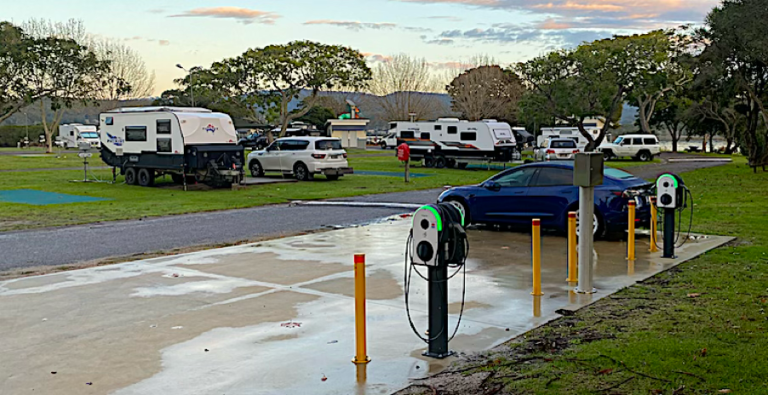
Most charging stops were to 80% or 90% state-of-charge, depending on the next leg. Overnight trickle charging was possible at caravan parks using the trailer’s 240V/10A outlet, with most parks permitting this and only one charging a $20 fee. Some parks, like Eden Reflections and NRMA Umina Beach, offered free EV charging for residents, while NRMA Shellharbour provided a 22 kW charger via Chargefox.
The trip involved 41 separate charging events (excluding home charging), and unhitching the trailer was necessary at six locations. Tight or multilevel carparks, especially in Wangaratta, posed the greatest inconvenience for trailer access.
Efficiency Impact of Towing
Total charging costs for the journey were A$658 (~$460). The average energy consumption was 23.4 kWh/100 km, but when isolating the 710 km (~441 miles) driven without the trailer (at the car’s lifetime average of 15.5 kWh/100 km), the real weighted average while towing was 24.5 kWh/100 km.
This means towing the 730 kg camper reduced the Model 3’s efficiency to 63% of its normal range. Typical long-distance travel days ranged from 400 to 500 km (~250 to 310 miles), with charging stops aligning well with rest breaks.
Competitor Comparison
For EV owners considering long-distance touring with a trailer, the Tesla Model 3 faces competition from models like the Hyundai Ioniq 6 and Nissan Leaf. The Hyundai Ioniq 6, priced at $39,095 (~AUD 55,911), offers an EPA-rated range of 240 miles (~386 km) in its standard-range SE trim, making it a close competitor in terms of price and modern features. The Nissan Leaf, with a price just below $30,000 (~AUD 42,904), is positioned as the most affordable alternative but offers less range and towing capability compared to the Model 3.
Historical Context
Tesla’s position in the EV market remains strong, but recent trends show a shift. In 2024, Tesla sold 634,000 vehicles in the U.S., down from 670,000 in 2023, marking an 8.4% year-over-year decline. Tesla’s U.S. market share was nearly 50% in 2024, slightly down from 49% in 2025. Globally, Tesla delivered 1.79 million vehicles in 2024, the first annual decline in over a decade.
Why this matters
This journey demonstrates that long-distance electric touring with a trailer is feasible, though it requires careful planning around charging stops and route selection. The significant drop in efficiency while towing highlights the importance of understanding real-world range impacts for EV owners considering similar adventures.
As charging infrastructure continues to expand and more caravan parks offer EV-friendly amenities, electric touring is becoming increasingly practical for a wider range of travellers.
What this means for buyers
Prospective EV owners interested in towing should factor in the substantial reduction in range and plan for more frequent charging stops. Checking ahead for EV-friendly caravan parks and being prepared to unhitch trailers at some charging locations can help minimize inconvenience.
Comparing models like the Tesla Model 3, Hyundai Ioniq 6, and Nissan Leaf can help buyers find the best fit for their travel needs, especially if long-distance towing is a priority.
Key Specs
- Vehicle: Tesla Model 3 (5 years old)
- Camper: Cub Drifter pop-top (50 years old)
- Camper Weight (loaded): 730 kg (~1,610 lbs)
- Trip Distance: 5,693 km (~3,538 miles)
- Trip Duration: 33 days
- Average Efficiency (towing): 24.5 kWh/100 km
- Charging Events: 41
- Total Charging Cost: A$658 (~$460)
Source
Images sourced from: whatcar.com, unpluggedperformance.com, thedriven.io

