
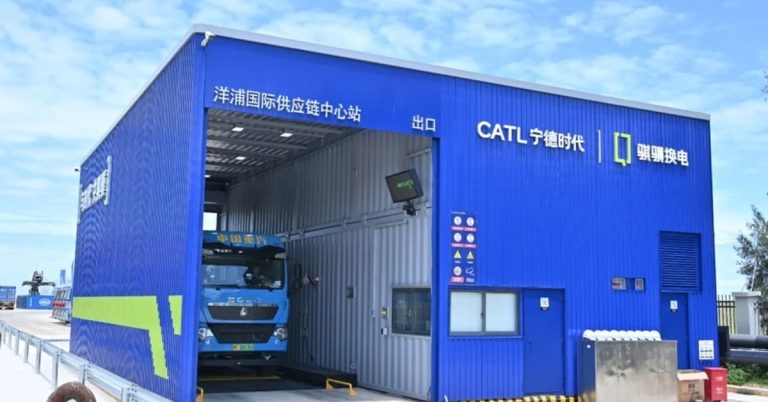
CATL has officially launched its Dual-Electric Range Extender technology, aiming to accelerate the electrification of heavy-duty trucks. The company also announced an ambitious expansion of its QiJi battery-swapping ecosystem, targeting thousands of stations across China.
Dual-Electric Range Extender Technology
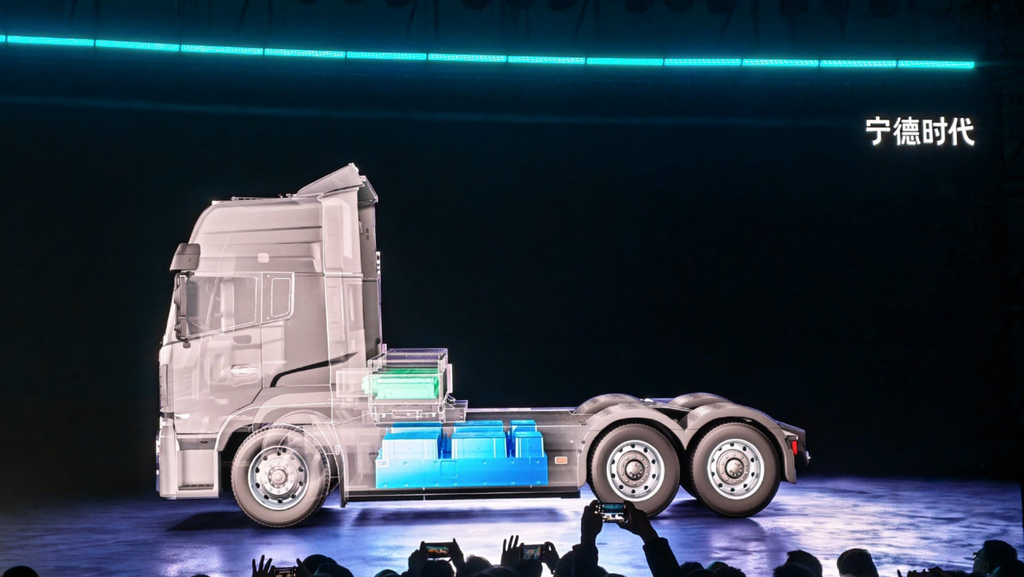
On October 20, CATL introduced its Dual-Electric Range Extender system, designed to address range and operational efficiency for electric heavy-duty trucks. The system uses an ‘A+B’ architecture: a bottom-mounted swappable battery (either 432 kWh or 513 kWh) as the primary power source, and a fixed 77 kWh range-extender battery pack for backup.
The primary battery can be deeply discharged down to 5% state of charge, after which the system automatically switches to the range-extender pack. This setup is intended to reduce range anxiety and enable continuous operation, with the main battery available through a flexible leasing model.
Battery-Swapping Ecosystem and Infrastructure Expansion
To support the new technology, CATL is expanding its QiJi battery-swapping network. The company has standardised battery blocks into two sizes: 260# (432 kWh) for 3,800 mm (~150 inches) wheelbase vehicles and 300# (513 kWh) for 4,200 mm (~165 inches) wheelbase vehicles.
Currently, five major trunk lines are operational, with over 5 million km (~3.1 million miles) of stable operation. CATL aims to have 900 battery-swapping stations by the end of 2026, 2,000 stations by 2027 to cover the national highway network, and an ultimate target of 10,000 stations.
Market Adoption and Industry Partnerships
According to CATL, over 430,000 electric heavy trucks already use its batteries, representing more than 70% of the global market. The penetration rate of electric heavy trucks in China has surged from 5.2% in 2022 to 50.28% as of September 2026.
At the launch event, CATL signed agreements with 14 major partners, including SF Express, ZTO Express, and YTO Express. The initial order volume from these agreements is 13,000 units.
Additional Tectrans II Products
CATL also introduced four specialised Tectrans II products to address specific operational needs within the heavy-duty transport sector. Details on these products were not specified in the announcement.
Why this matters
The rapid adoption of electric heavy trucks in China, combined with CATL’s new battery-swapping technology and expanding infrastructure, signals a major shift in commercial transport. The Dual-Electric Range Extender system is designed to improve operational efficiency and reduce costs compared to diesel trucks.
With significant industry partnerships and a growing network of battery-swapping stations, CATL is positioning itself as a key player in the electrification of heavy-duty logistics.
What this means for buyers
Fleet operators and logistics companies considering electric heavy trucks can look to CATL’s Dual-Electric Range Extender system for improved range flexibility and reduced downtime. The expanding QiJi battery-swapping network may offer greater operational convenience as more stations come online.
Potential buyers should monitor the rollout of new stations and the availability of compatible vehicles to assess how these developments could benefit their operations.
Key Specs
- Primary Swappable Battery Capacity: 432 kWh or 513 kWh
- Range-Extender Battery Capacity: 77 kWh
- Battery Swap Time: 5 minutes
- Standardised Battery Sizes: 260# (432 kWh) for 3,800 mm (~150 inches) wheelbase; 300# (513 kWh) for 4,200 mm (~165 inches) wheelbase
- Electric Heavy Trucks Using CATL Batteries: Over 430,000
- Market Penetration in China (September 2026): 50.28%
- Estimated 3-Year Cost Savings vs Diesel: $68,731 (~AUD 98,685)
- Initial Order Volume from Partners: 13,000 units
Images sourced from: carnewschina.com, ttnews.com

