
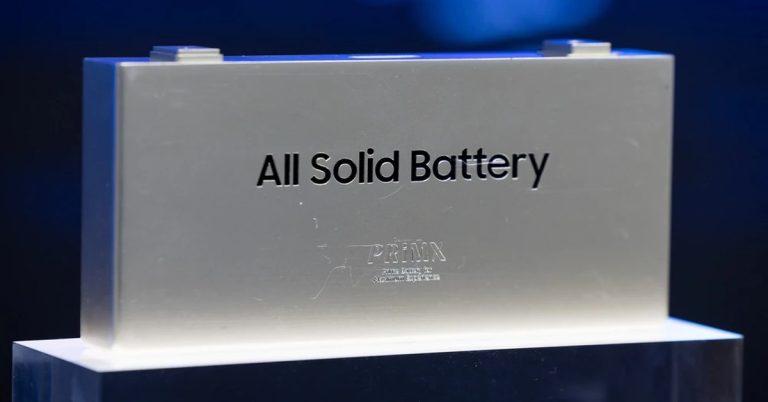
Sunwoda and CATL, two major Chinese battery suppliers, are pursuing different approaches to solid-state battery technology. Sunwoda has confirmed ongoing customer evaluation of its polymer-composite cells, while CATL maintains its goal for small-batch sulfide-based battery production in 2027.
Sunwoda’s Polymer-Composite Solid-State Battery Progress
Sunwoda Electric Vehicle Battery Co., Ltd. (SEVB), a subsidiary of Sunwoda Electronic Co., Ltd., provided an update on its solid-state battery development on October 30 via the Shenzhen Stock Exchange’s investor interaction platform. The company reported that its 20 Ah Xin Bixiao cell, which uses a polymer-composite electrolyte, has completed design and process verification and is currently under evaluation by unnamed automakers.
The Xin Bixiao cell features a 12-micron polymer-composite membrane and a nanoscale high-entropy silicon anode. It achieves an energy density of 400 Wh/kg and a cycle life exceeding 1,200 cycles under external pressure below 1 MPa. The cell has also passed a 200°C hot-box test. Sunwoda did not disclose the identities of the automakers involved or the sample volumes.
CATL’s Sulfide-Based Solid-State Battery Timeline
CATL reaffirmed its target for small-batch production of sulfide-based solid-state batteries in 2027, according to an investor response dated October 27. CATL had previously reported a 20 Ah solid-state prototype in 2024. Sulfide-based designs typically require moisture-controlled manufacturing due to the risk of hydrogen sulfide (H₂S) release when exposed to water.
Pilot Production and Aviation Battery Initiatives
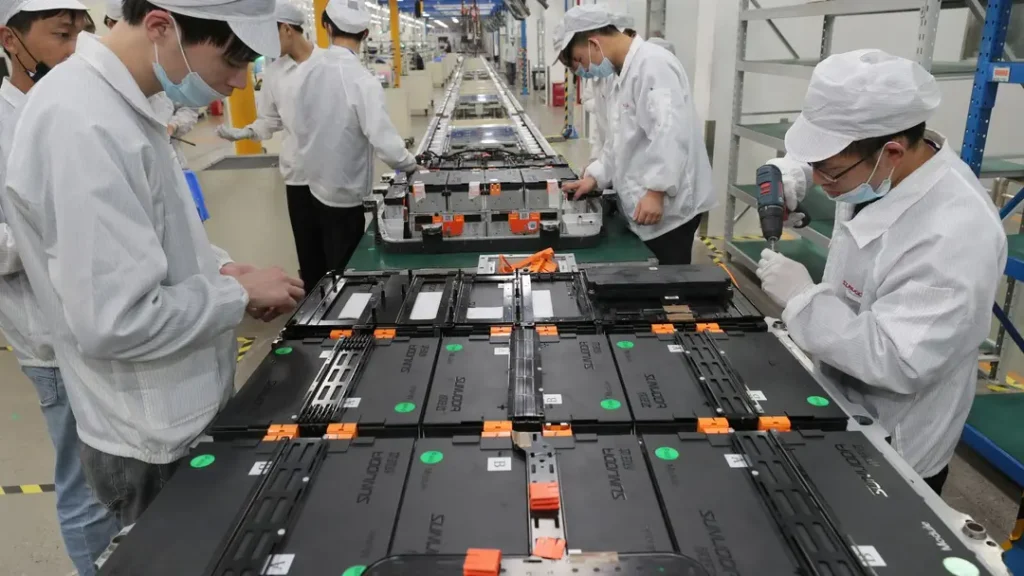
SEVB has established a solid-state battery pilot line with an annual design capacity of 0.2 GWh. The company’s roadmap includes a second-generation sulfide battery targeted for 2027 and a future cell with energy density exceeding 500 Wh/kg by 2030. These remain development targets and are not confirmed production dates.
Sunwoda is also participating in the Guangdong Engineering Research Centre for Aviation Power Batteries. The centre has set a target of at least 450 Wh/kg for aviation battery cells and a continuous discharge power density of at least 1,000 W/kg for eVTOL applications. These targets do not represent commercial orders or production volumes.
Material Costs and Shareholder Developments
The cost of sulfide electrolytes remains significantly higher than conventional liquid electrolytes. Shanghai Metals Market has assessed lithium phosphorus sulfur chloride (Li₆PS₅Cl) at approximately $525 (~AUD 748) to $676 (~AUD 961) per kilogram, compared to $5 (~AUD 6) to $8 (~AUD 11) per kilogram for standard liquid electrolytes.
Li Auto agreed to invest $397.8M (~AUD 566M) for an initial 8.79% stake in SEVB, while Xiaomi has proposed a $255.2M (~AUD 363.1M) investment for a 5.34% stake, pending shareholder approval. Following the proposed transaction, Li Auto would hold about 8.32% of SEVB, making it the second-largest shareholder, with Xiaomi as the third-largest.
Why this matters
The progress of Sunwoda and CATL highlights the diversity of approaches in the solid-state battery field, with each company pursuing different electrolyte chemistries and production strategies. The development of higher energy density batteries could have significant implications for both electric vehicles and aviation, though commercial viability will depend on successful validation and scalable manufacturing.
What this means for buyers
For consumers and industry stakeholders, these developments indicate that solid-state batteries are advancing but are not yet commercially available in vehicles. Buyers should watch for further announcements regarding vehicle-level validation and production timelines before expecting these technologies in mass-market EVs.
Key Specs
- Cell Type: Polymer-composite solid-state (Sunwoda Xin Bixiao)
- Cell Capacity: 20 Ah
- Energy Density: 400 Wh/kg
- Cycle Life: Exceeds 1,200 cycles (below 1 MPa pressure)
- Membrane Thickness: 12 microns
- Anode: Nanoscale high-entropy silicon
- Thermal Test: Passed 200°C hot-box test
- Pilot Line Capacity: 0.2 GWh per year
Images sourced from: manlybattery.com

