
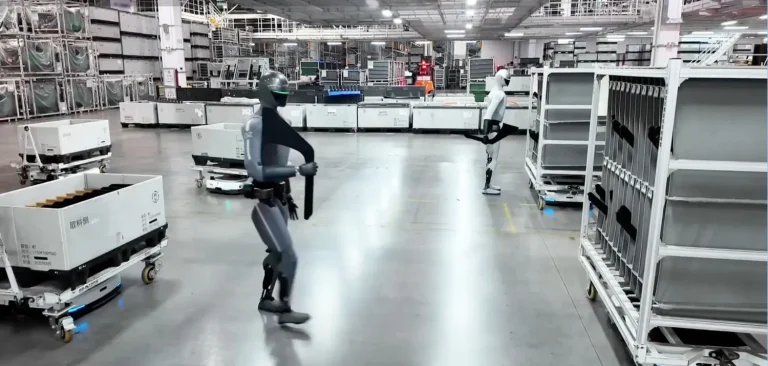
Xiaomi has released new footage showing its humanoid robots working a full 8-hour shift at its electric vehicle factory, autonomously sorting center console side covers. The company claims the robots detected and corrected their own errors, coordinating directly with the production line’s control system. This demonstration is the latest in a series of public milestones for Xiaomi’s robotics program.
Xiaomi’s Robots Take on Real Factory Work
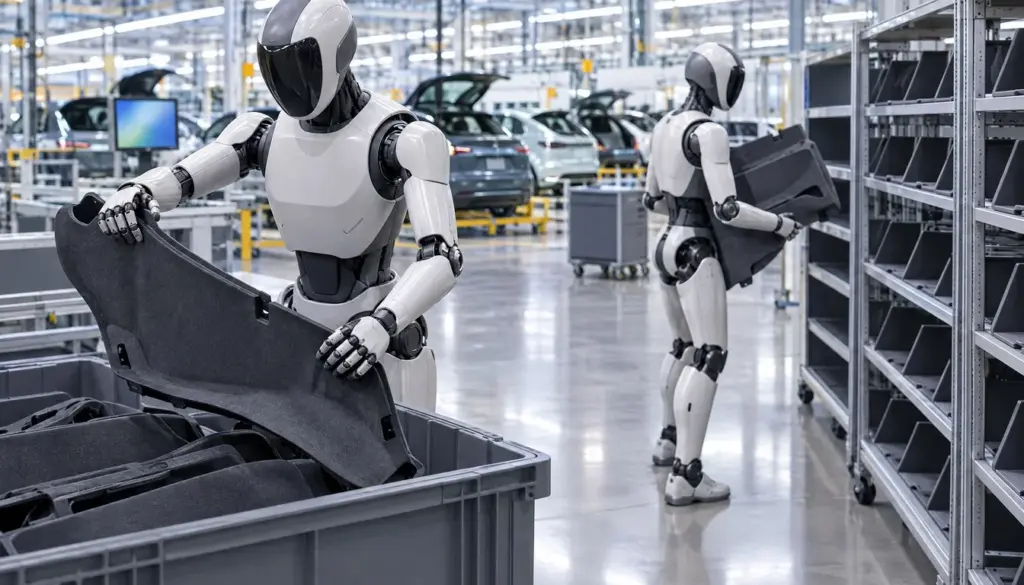
On November 3, Xiaomi Tech posted a video on X showing its humanoid robots performing an entire day’s production at a workstation in its EV factory. The robots were seen pulling side covers from bins, transporting them to storage racks, and placing them into designated slots. The video included a running clock of cumulative working time and a label reading ‘Autonomous, 100x Speed.’
According to Xiaomi, the robots operated independently, detecting and correcting anomalies as they worked and coordinating with the factory’s control system. The company described this as ‘another step toward real-world industrial deployment.’
Progress in Xiaomi’s Robotics Program
This latest demonstration follows a series of public tests throughout 2026. In March, Xiaomi placed a humanoid robot as an ‘intern’ in its Beijing EV factory, where it installed self-tapping nuts with a reported 90.2% success rate over three hours—fast enough to meet the station’s 76-second cycle time. By July, Xiaomi reported an improved success rate of 98% and expanded the robot’s tasks to include more complex stations, such as the side-cover sorting job featured in the recent video.
Last December, CEO Lei Jun announced plans to deploy humanoid robots in large numbers across Xiaomi’s factories within five years. The company has also begun trial runs of its open-source Xiaomi-Robotics-1 AI model, which is pre-trained on 100,000 hours of real-world robot data. In a 30-minute test in Xiaomi staff apartments, the AI completed over 50 task chains across three rooms.
How Autonomous Was the Shift?
While Xiaomi’s video highlights the robots’ autonomy, key details remain undisclosed. The company did not specify how many parts were sorted during the 8-hour shift, the exact success rate over that period, or whether human intervention was required. It also did not clarify how the robots maintained power for a full shift—whether through battery swaps, tethers, or charging breaks.
These details are important, as previous industry demonstrations have sometimes relied on remote human operation. For example, Tesla’s Optimus robots at the 2024 ‘We, Robot’ event were later revealed to be remotely operated, and Tesla now says it will not deliver Optimus to outside customers until late 2027.
Wheels Versus Legs: The Role of Mobile Platforms
A notable moment in Xiaomi’s video occurs around the 1:37 mark, where a humanoid upper body mounted on a wheeled base assists the legged robots. Additionally, bins of parts are moved by autonomous mobile robots—wheeled platforms that have been standard in car factories for years.
Wheeled bases offer several advantages in a factory setting, including greater stability when carrying parts, space for larger batteries, and reduced need for complex actuators compared to legged robots. While humanoid robots may eventually be suited for environments like homes with stairs, wheels remain highly efficient for flat factory floors.
Competitor Comparison
Xiaomi’s progress in deploying humanoid robots in real production settings stands out compared to competitors such as Tesla. While Xiaomi has published success rates and cycle times for its robots, Tesla has not released similar operational data for its Optimus robots and has delayed commercial deployment until at least late 2027.
Other manufacturers continue to rely on wheeled autonomous mobile robots for material handling, highlighting the ongoing debate over the practicality of humanoid versus wheeled platforms in industrial environments.
Historical Context
Xiaomi’s robotics program has shown rapid progress over the past year, with success rates for factory tasks improving from 90.2% in March 2026 to 98% by July 2026. The company’s commitment to deploying robots at scale within five years signals a significant shift in manufacturing automation.
Meanwhile, electricity rates have risen nearly 10% in the past year, increasing the importance of efficient automation and energy management in factories.
Why this matters
Xiaomi’s demonstration of humanoid robots working autonomously for a full shift represents a significant step toward integrating advanced robotics into real-world manufacturing. If the robots can consistently operate with minimal human intervention, this could accelerate the adoption of robotics across the automotive industry.
The company’s willingness to share operational data, even if limited, sets it apart from some competitors and may encourage greater transparency in the field.
What this means for buyers
For consumers and industry observers, Xiaomi’s advancements suggest that robotics and AI are becoming increasingly central to EV manufacturing. Buyers interested in the latest technology trends should watch for further updates on the performance and deployment of these robots, as well as potential impacts on production efficiency and vehicle pricing.
As automation expands, regional availability of Xiaomi’s EVs and related technologies may also increase, making it important for buyers to stay informed about new developments and market rollouts.
Key Specs
- Factory Task: Sorting center console side covers
- Shift Duration: 8 hours
- Reported Success Rate (March 2026): 90.2% over 3 hours
- Improved Success Rate (July 2026): 98%
- AI Model Training Data: 100,000 hours
- AI Apartment Trial: 50+ task chains in 30 minutes
- CEO Deployment Timeline: Large-scale deployment within 5 years

