
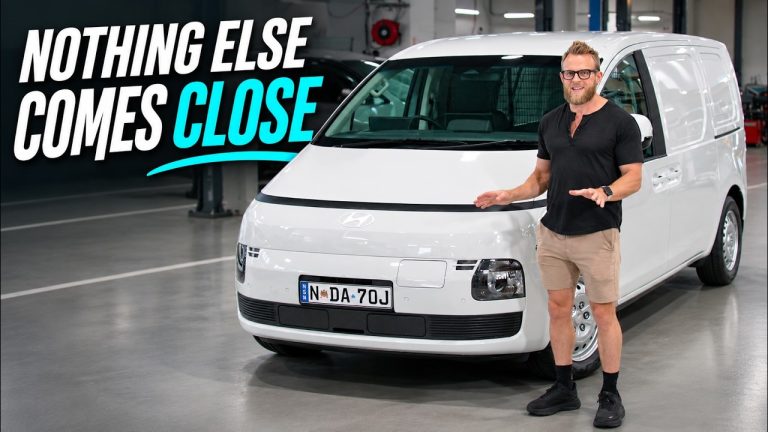
The Hyundai Staria Load Electric has arrived in Australia, priced at A$71,400 (~$50,012) and offering a 450km WLTP range from its 84kWh battery. With a 1,005kg payload, 2,000kg towing capacity, and 800V ultra-fast charging, it stands out as the most capable electric van currently available for commercial buyers.
Design and Practicality: Familiar Looks, Smarter Choices
The Staria Load Electric looks much like its diesel counterpart, with subtle differences like a revised grille and a slightly wider wind visor. At 5.23 meters long, 2 meters wide, and 2 meters tall, it’s a sizeable van with a massive 4,935-litre cargo space. One key advantage is that the load floor is the same height as the diesel version, thanks to clever battery packaging. This means you get more usable space and easier loading compared to other electric vans, which often have higher floors due to battery placement.
There are two rear door options: a large lift gate or a split tailgate. I prefer the lift gate for its practicality—ideal for sitting at the back with surfboards or gear. The van’s payload of 1,005kg and 2,000kg braked towing capacity make it a true workhorse, matching or exceeding most rivals.
Interior Features: Comfort and Utility
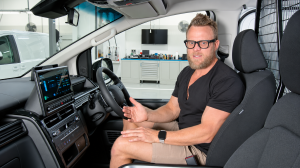
Inside, the Staria Load Electric feels more upmarket than the average commercial van, with premium-looking panels and thoughtful touches. There’s a huge central storage area—big enough for a large bowl of food—plus three cup holders, two charging ports (USB-C and 12V), and a traditional glove box, which is rare in EVs.
The gear shifter is mounted on the steering column, freeing up space between the seats for easier walk-through access—handy for couriers. There’s also a wireless charging pad with a grippy surface to keep your phone secure. The van features two 12.5-inch screens: one for the driver, one for infotainment, both easy to see and use. Hyundai’s own navigation system works impressively well, even outperforming Waze in my experience.
Climate control is dual-zone, and the system can detect if only the driver is present, directing air solely to that area for efficiency. There’s also a 3.6kW vehicle-to-load outlet—perfect for plugging in tools or a kettle on the job site.
Technology and Security
The Staria Load Electric includes Hyundai’s Blue Link system, which adds stolen vehicle tracking, remote lock/unlock, climate preconditioning, and charge scheduling. You can locate the van on a map, whether misplaced or stolen. Another standout is the automatic SOS collision notification, which contacts emergency services if you crash—rare in commercial vehicles.
The charging port is located at the front center, a practical placement for most charging stations. When I tested it on a 40kW DC charger, it was charging at 32kW with 92% battery, showing efficient charging management. The van’s 800V architecture supports up to 350kW charging, allowing a 10–80% top-up in just 20 minutes under ideal conditions.
Driving Experience: Comfort, Power, and Efficiency
Driving the Staria Load Electric was a pleasant surprise. The independent rear suspension with coil springs delivers a far superior ride to the leaf springs found in most one-tonne vans. Even with 360kg of sandbags in the back, the van handled bumps and hills smoothly, and traction was solid.
The van is rated at 160kW, but it feels more powerful than other vehicles with similar specs. Energy efficiency impressed me: I used just 9% of the battery over my test drive, averaging 19kWh/100km—better than Hyundai’s official 20kWh/100km figure. Regenerative braking is well-integrated and easy to monitor on the screen, making efficient driving almost a game.
The steering wheel is packed with useful controls, including a drive mode button for quick switching between Normal, Eco, Sport, and Snow modes. Cruise control is accurate and reliable, holding the set speed even on descents.
Practicalities and Ownership Costs
The Staria Load Electric is only available as a two-seater with cloth seats—no premium trim or three-seat option. It comes with steel wheels and halogen headlights, which I think is a sensible choice for a work van. Hyundai’s seven-year warranty doesn’t apply to commercial vehicles, but business buyers get five years or 160,000km, with the battery covered for eight years.
Charging costs can be minimal if you use rooftop solar or off-peak power—potentially just one or two dollars per charge. For a van covering 40,000km annually, fuel savings could be between A$3,500 (~$2,452) and A$5,000 (~$3,502) per year. Servicing is low at A$686 (~$481) for the first two years, thanks to the simplicity of EVs.
Comparisons: How It Stacks Up
The main rival is the Ford E-Transit Custom, starting at A$77,600 (~$54,355) with a 64kWh battery, 300km range, and 125kW charging (taking about 32 minutes for a 15–80% charge). The Staria Load Electric is A$7,000 (~$4,903) cheaper, offers more range, faster charging, and higher payload. Kia’s upcoming PV5 is priced at A$56,000 (~$39,225) with 416km range and 530kg payload, but it’s a smaller van with slower 400V charging (around 30 minutes for a charge).
What This Means for Buyers and the Market
I think the Hyundai Staria Load Electric is the first electric van in Australia that truly works like a van should—offering real-world range, payload, and charging speed without sacrificing comfort or practicality. For businesses, the running cost savings, fast charging, and usable cargo space make it a compelling choice. While it’s not perfect—limited seating and no premium version—it’s a massive step forward for commercial EVs here.
There’s also a passenger version in Korea with up to seven seats, which would be fantastic for families if Hyundai brings it to Australia. As it stands, the Staria Load Electric sets a new benchmark for what an electric van can be, and I think it will push other manufacturers to lift their game.

