
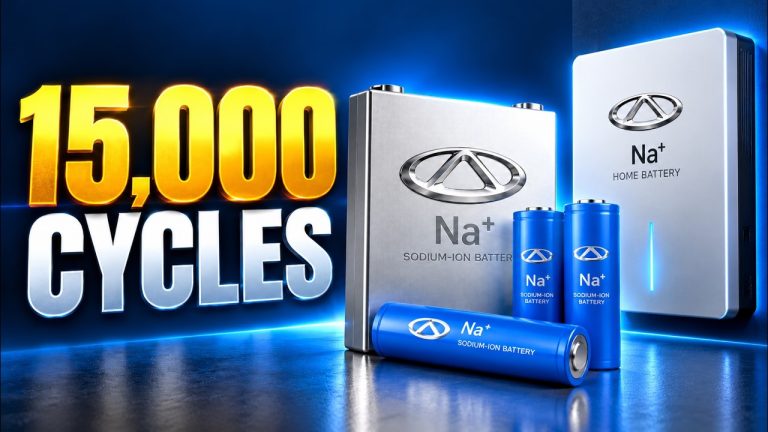
Chery, now one of the world’s six largest automakers, has revealed a new sodium-ion battery for stationary storage with a rated lifespan of 15000 cycles. This figure far exceeds the typical cycle ratings of current home batteries, potentially offering up to 41 years of daily use. While Chery has not disclosed the battery’s price, launch date, or energy density, the company is targeting homes, businesses, and industrial sites as part of a broader energy ecosystem strategy.
What 15000 Cycles Means for Home Storage
A battery cycle consists of one full charge and one full discharge. Most home batteries, such as those using lithium iron phosphate (LFP) chemistry, are rated for between 5000 and 8000 cycles, with top-end models like the latest Anker Solix reaching 9000 cycles. This typically translates to 15 to 20 years of daily use before noticeable degradation occurs. In contrast, Chery’s sodium-ion battery, rated for 15000 cycles, could last 41 years with daily cycling. Even with twice-daily cycles, the battery would still offer over 20 years of service, potentially outlasting the roof it is installed under.
Possible Chemistry Behind the Longevity
Chery has not detailed the specific chemistry of the new battery beyond confirming it is sodium-ion. Sam Evans believes the high cycle life likely indicates a sodium-ion pyrophosphate cathode, a chemistry similar to that used in CATL’s storage-grade sodium cells. This approach uses no lithium, cobalt, or nickel, making the batteries cheaper to manufacture. However, Chery has not provided energy density figures, which are a key trade-off for this chemistry.
Energy Density and Application Suitability
Sodium pyrophosphate cells usually offer energy densities between 100 and 130 watt-hours per kilogram, with exceptional cases like CATL reaching 175. This is roughly two-thirds the energy density of LFP cells, making sodium less suitable for vehicles due to weight concerns. However, for stationary storage—such as home batteries or grid-scale containers—size and weight are less critical. Additionally, sodium-ion batteries perform better in cold temperatures, charging efficiently at minus 20 degrees Celsius, which is a significant advantage in colder climates like Canada and the UK.
Chery’s Broader Energy Strategy
The new sodium-ion battery is part of Chery’s larger plan to integrate cars, stationary storage, chargers, grid solutions, cloud services, and carbon management under one platform. This mirrors the strategies of industry leaders like BYD and Tesla, who bundle vehicles with home and grid storage solutions. Chery also announced other battery products, including a solar-state battery, as part of this comprehensive approach.
Price and Market Impact
Chery has not yet announced a price or launch date for the sodium-ion battery. While sodium-ion technology is expected to be cheaper than lithium or LFP, LFP’s massive production scale has kept its costs extremely low, and sodium has not yet achieved price parity. Sam Evans believes that if Chery can match LFP on cost, a 40-year home battery could transform the economics of solar and storage for both homeowners and grid operators. Until pricing and energy density are confirmed, the 15000-cycle rating remains an impressive figure but not yet a market disruptor.
What It Means for the Industry
If Chery delivers on its promises and sodium-ion batteries reach cost parity with LFP, the extended lifespan could make home and grid storage much more attractive and cost-effective. This would benefit not only individual homeowners but also utilities and businesses seeking long-term, low-maintenance energy storage solutions. However, the true impact will depend on whether Chery can bring these batteries to market at a competitive price and with adequate energy density for practical use.

