
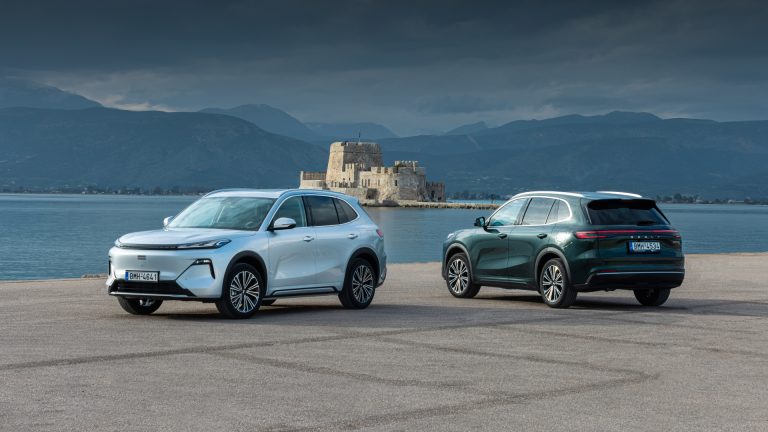
Geely Auto has released its third quarter 2026 financial results, revealing that exports are now responsible for nearly all of the company’s profits. Despite strong sales volumes in China, the domestic market remains challenging, with most earnings coming from international sales.
Geely’s Q3 2026 Financial Performance
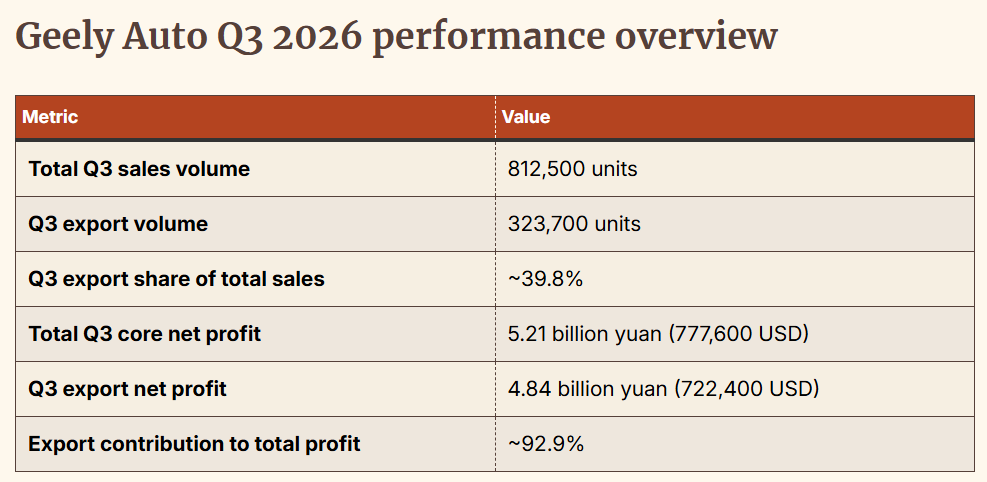
On October 29, 2026, Geely Auto reported a total revenue of $14.8B (~AUD 21B) for the third quarter, with a core net profit attributable to the parent company of $779.9M (~AUD 1.1B). The company’s total sales volume for the quarter reached 812,500 units, including exports.
Exports played a critical role, with 343,700 vehicles shipped overseas in Q3 2026. This led Geely to raise its annual export target from 640,000 to 920,000 units for the year.
Exports Dominate Profitability
Geely’s export operations generated $724.5M (~AUD 1B) in net profit during the third quarter, accounting for 92.9% of the company’s total profits. While exports made up 39.8% of total sales, they contributed the overwhelming majority of earnings.
In contrast, more than 60% of Geely’s sales in China contributed just 7% of profits, highlighting the intense competition and slim margins in the domestic market.
New Energy Vehicles Fuel Export Growth
New energy vehicles (NEVs) have become central to Geely’s export strategy. In the first three quarters of 2026, the company exported 484,000 NEVs, marking a 531% increase compared to the previous year.
This surge underscores the growing importance of NEVs in Geely’s international business and the company’s ability to capture demand in overseas markets.
Competitor Comparison
BYD, China’s largest NEV manufacturer, also released its Q3 2026 results on the same day. BYD reported revenue of $33.2B (~AUD 47.1B), up 13.59% year-on-year, and a net profit of $1.5B (~AUD 2.1B), a 28.08% increase. In September 2026 alone, BYD exported over 180,700 NEVs, a year-on-year rise of approximately 153.6%.
Geely remains the second-largest private Chinese carmaker after BYD, but faces similar pressures in the domestic market, where profitability is increasingly difficult to achieve.
Historical Context
Geely’s sales in 2025 totaled 3,024,567 units, representing a 39% year-on-year increase. Despite this growth, the latest results show that expanding volume does not necessarily translate to higher domestic profitability.
The Chinese automotive market continues to see exits from brands such as Neta, Weltmeister Motor, HiPhi, and Aiways, reflecting the ongoing shakeout among manufacturers.
Why this matters
Geely’s Q3 2026 results highlight the challenges facing Chinese automakers in their home market, where heavy competition has eroded profit margins. The company’s reliance on exports for nearly all of its profits signals a major shift in strategy and underscores the importance of international markets for future growth.
The rapid growth in NEV exports also reflects broader trends in the global automotive industry, as Chinese manufacturers seek new opportunities abroad amid a crowded domestic landscape.
What this means for buyers
Buyers in China can expect continued aggressive pricing and a wide range of choices as automakers compete for market share, but this may also lead to further consolidation in the industry. For international buyers, Geely’s focus on exports and NEVs could mean increased availability of new models and technologies in overseas markets.
Those considering a Geely or other Chinese brand should watch for ongoing changes in product offerings and potential impacts from market exits or restructuring.
Key Specs
- Q3 2026 Revenue: $14.8B (~AUD 21B)
- Q3 2026 Core Net Profit: $779.9M (~AUD 1.1B)
- Q3 2026 Export Volume: 343,700 vehicles
- Q3 2026 Total Sales Volume: 812,500 vehicles
- Q3 2026 Export Profit Contribution: 92.9% of total profit
- Q3 2026 Export Sales Share: 39.8% of total sales
- NEV Exports (First Three Quarters 2026): 484,000 vehicles (531% YoY increase)
- Annual Export Target (2026): 920,000 vehicles
Images sourced from: carnewschina.com, geely.de, geely.am

