
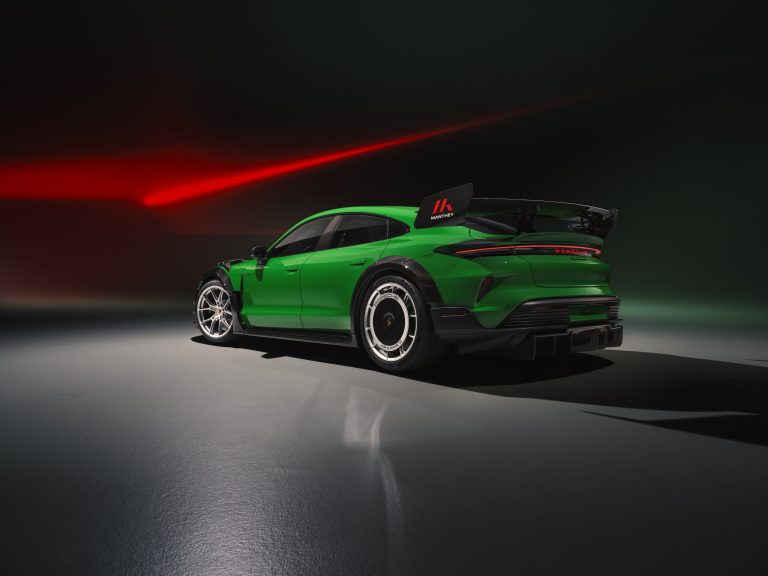
Porsche has added a new Manthey Kit to the Taycan Turbo GT, building on the Weissach Package to sharpen the electric sedan for track use. The upgrades increase downforce, add power, and help the car post a 6:55.553 Nürburgring lap, edging past the production Xiaomi SU7 Ultra and reclaiming the EV benchmark in the executive-car class.
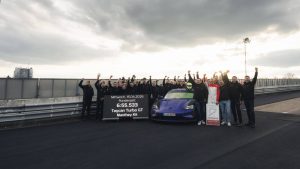
Porsche has given the Taycan Turbo GT another round of track-focused upgrades, this time through a new Manthey Kit developed with Manthey’s engineering team. The package sits on top of the existing Weissach Package and has already helped the electric sedan record a 6:55.553 lap of the Nürburgring Nordschleife with development driver Lars Kern.
That lap is 12 seconds quicker than a standard Taycan Turbo GT and more than nine seconds faster than the production Xiaomi SU7 Ultra’s 7:04.957. It also puts Porsche back in front in the race for the fastest production EV in the executive-car segment, after Xiaomi briefly held the advantage.
It is worth separating production cars from prototypes. Xiaomi’s prototype lap of 6:22.091 from June 2025 was much faster, but it does not count as a production-vehicle record.
What the Manthey Kit changes
The new package was developed jointly by Porsche’s Weissach center and Manthey’s engineers in Meuspath, Germany, with a motorsport-led brief. Porsche says the kit combines aerodynamic changes, more power, lighter wheels, track-oriented tires, and revised suspension tuning.
In practical terms, the Taycan Turbo GT becomes even more focused on circuit work. The changes are aimed at improving high-speed stability, cornering grip, braking consistency, and overall lap time rather than comfort or everyday range.
Aerodynamics push the car deeper into track territory
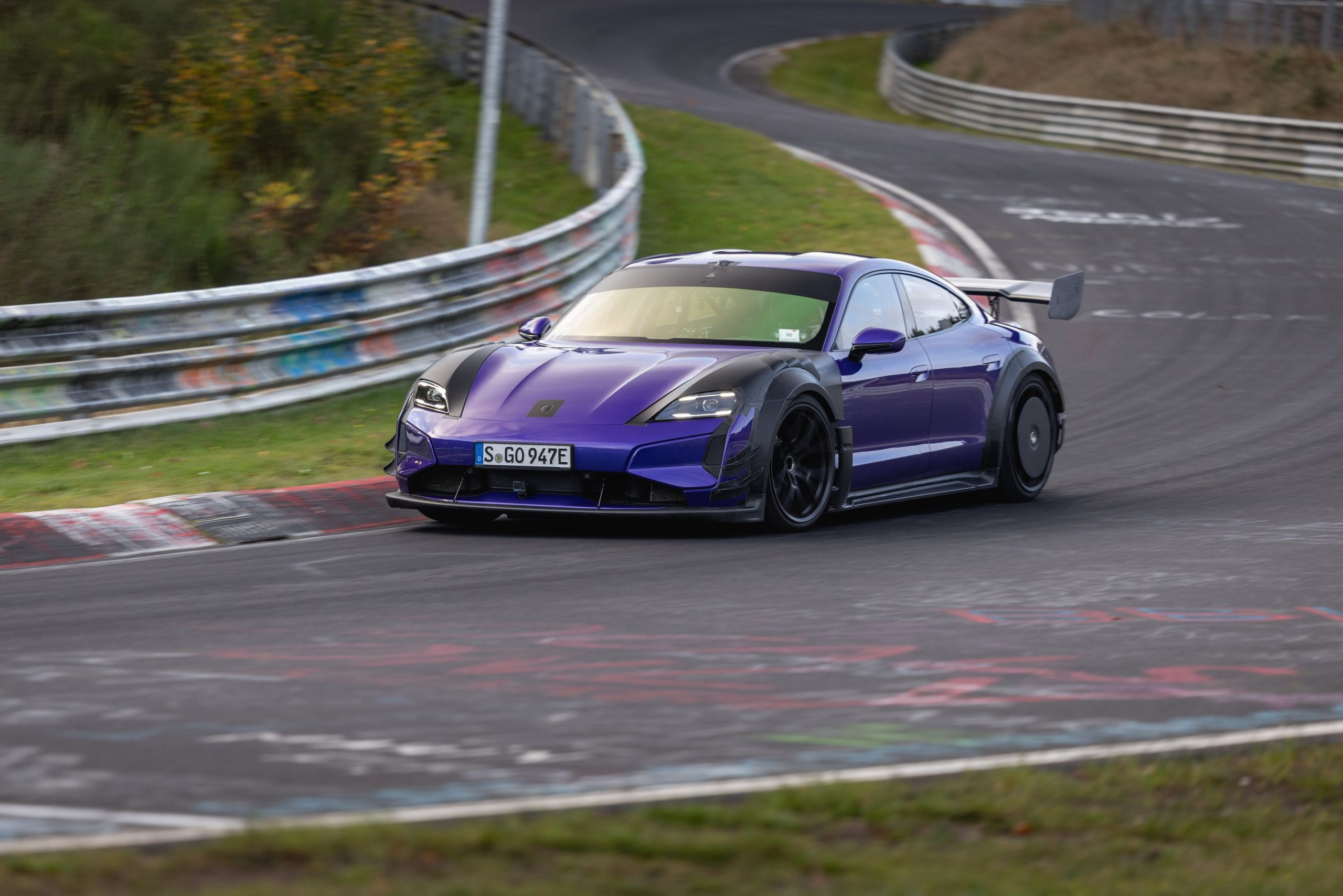
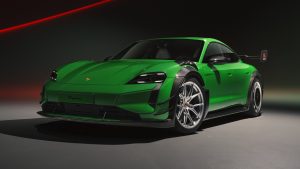
Visually, the Manthey-equipped Taycan Turbo GT is much more aggressive than the standard car. Up front, it gains an adjustable splitter, canards, and GT3-style fender vents, while the sides are widened with new fender extensions and deeper skirts.
At the rear, Porsche adds a larger manually adjustable wing and a revised diffuser. The car also rides on lighter 21-inch forged aluminum wheels, with carbon aero discs on the rear axle and titanium wheel bolts.
Porsche says the wheel changes cut unsprung mass by 6 pounds, or 2.7 kg. The wider performance tires are part of the same effort to increase grip and make better use of the extra aero load.
Downforce and speed rise together
According to Porsche, the Manthey Kit more than triples downforce compared with the standard setup. At 200 km/h (124 mph), downforce rises from 95 kg (209 lb) to 310 kg (683 lb).
At the Taycan Turbo GT’s top speed of 309 km/h (192 mph), Porsche says the car generates 740 kg (1,631 lb) of downforce. The top speed is also 5 km/h, or 3 mph, higher than before.
More power, but still not the most powerful on paper
The electric powertrain gets a modest output increase as part of the package. In standard form, total output rises to 804 hp (600 kW / 815 PS), while Attack mode lifts it to 978 hp (730 kW / 993 PS).
Those figures are up by 27 hp and 40 hp respectively over the regular Taycan Turbo GT. With launch control engaged, Porsche says total output remains at 1,019 hp (760 kW / 1,033 PS), while torque increases by 22 lb-ft to 936 lb-ft (1,269 Nm).
Even with the extra punch, the Taycan still trails the Xiaomi SU7 Ultra on peak numbers. Xiaomi’s car is rated at 1,526 hp (1,138 kW / 1,548 PS) and 1,770 Nm (1,305 lb-ft) of torque.
Chassis and braking changes support the aero gains
The aero and power changes are matched by revisions to the Porsche Active Ride suspension, four-wheel steering, and all-wheel-drive systems. Porsche has also upgraded braking with 440 mm front discs and performance brake pads.
That combination matters because the Nürburgring rewards not only straight-line speed, but also stability under braking, balance through fast corners, and confidence in long, demanding stints. A package like this is meant to make the car faster over a full lap, not just in a drag-style acceleration run.
Why this lap matters
For Porsche, the result is as much about engineering credibility as bragging rights. The Nürburgring remains one of the most respected proving grounds for performance cars, and reclaiming the EV benchmark helps Porsche counter the growing pace of Chinese rivals in this segment.
Lars Kern said the Manthey package turns the Taycan Turbo GT with Weissach Package into “the ultimate track tool.” He also noted that the upgrades allowed him to carry 14 km/h (8.7 mph) more speed through the Lauda-Lefthander section than on his previous run.
In a market where electric performance cars are increasingly judged by lap times as much as output figures, Porsche’s latest upgrade shows the Taycan platform still has room to evolve. It also signals that the battle for EV performance leadership is far from settled.
Why This Matters
This story matters because it shows how quickly the performance EV field is escalating. Porsche is not only chasing outright speed, but also using aero, chassis tuning, and track development to defend its reputation against increasingly capable rivals from China.
The Nürburgring remains a key benchmark for enthusiasts and manufacturers alike. A verified production-car lap time carries marketing weight, but it also reflects real gains in braking, grip, cooling, and stability that can influence the design of future performance EVs.
Key Specs
- Model: Porsche Taycan Turbo GT with Manthey Kit
- Lap time: 6:55.553 at the Nürburgring Nordschleife
- Driver: Lars Kern
- Comparison vs. standard Taycan Turbo GT: 12 seconds quicker
- Comparison vs. Xiaomi SU7 Ultra production car: More than 9 seconds quicker
- Downforce at 200 km/h (124 mph): 310 kg (683 lb), up from 95 kg (209 lb)
- Downforce at top speed: 740 kg (1,631 lb)
- Top speed: 309 km/h (192 mph), 5 km/h (3 mph) higher than before
- Power in standard form: 804 hp (600 kW / 815 PS)
- Power in Attack mode: 978 hp (730 kW / 993 PS)
- Launch control output: 1,019 hp (760 kW / 1,033 PS)
- Torque with launch control: 936 lb-ft (1,269 Nm)
- Front brakes: 440 mm discs
- Wheel size: 21-inch forged aluminum wheels
- Unsprung mass reduction: 6 lb (2.7 kg)
Source: Carscoops

