
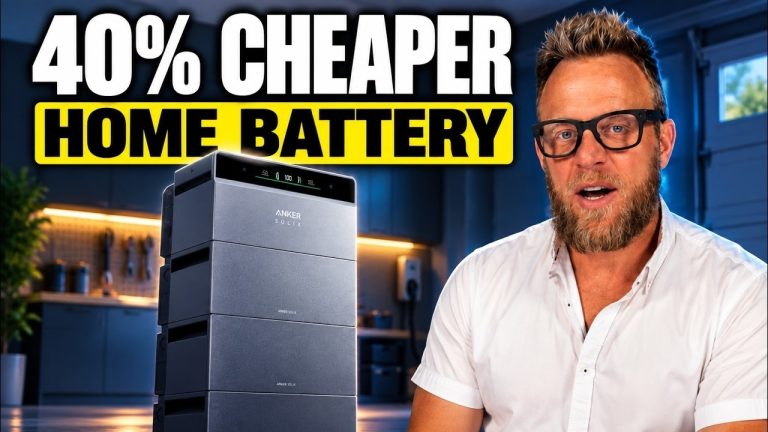
Anker has released its new Solix XE home battery system, offering a major leap in value for homeowners looking to store solar or off-peak grid energy. The XE, now available in Australia, the UK, and Ireland, costs less than the previous X1 model and boasts a lifespan of 10,000 charge cycles—two-thirds more than the X1’s 6,000 cycles. This translates to a roughly 40% lower real cost of stored energy, dropping from about 14 cents to 8.5 cents per kilowatt-hour (AUD).
Longer Life and Lower Cost per Cycle
The XE uses the same lithium iron phosphate chemistry as the X1, but upgrades to large 314Ah cells similar to those found in grid-scale battery farms. This is the key to its extended 10,000-cycle life. In Australia, Anker systems sell for around A$800 (~$558) to A$900 (~$628) per kilowatt-hour installed before rebates (about $530 (~AUD 760) to $600 (~AUD 861)). The XE comes in slightly under the price of the X1, making it even better value on day one.
When you divide the cost by the cycle life, the X1 works out to about 14 cents per kilowatt-hour (AUD) per cycle, while the XE drops to around 8 cents. That’s at least a 40% discount on the real cost of energy storage, and you get more cycles for less money up front.
Designed for Double Daily Cycling
Unlike most home batteries, which are typically designed for one cycle per day, the XE is built to handle two full cycles daily. The idea is to fill the battery with solar during the day and power the home during the evening peak, then recharge overnight with cheap off-peak grid power to cover the morning. A 7 kWh XE can deliver up to 14 kWh of usable energy every day.
On a 6,000-cycle battery, that kind of usage would use up the rated life in about 8 years—still inside the 10-year warranty, but with reduced performance. With the XE’s 10,000 cycles, you get nearly 14 years of double-daily cycling, and Anker designed it for a 15-year lifespan. For most users, who will likely cycle it once per day, the XE could last up to 28 years.
All-in-One Stackable Design
The XE changes the game with its all-in-one box design, combining a 7 kWh battery, inverter, and wireless meter. There’s no need for separate cabling or drilling holes in the wall. You can choose inverter sizes from 5, 8, 10, or 15 kW to suit your home, and a single stack can support up to 30 kW of solar input.
Adding capacity is as simple as stacking more battery modules. One stack can reach up to 42 kWh, and two stacks side-by-side give you 84 kWh. The system uses every last kilowatt-hour, with no hidden reserve, and two units (14 kWh each) align perfectly with the Australian battery rebate, which covers up to 28 kWh.
Options for Apartments and Plug-and-Play Solutions
Anker has also introduced solutions for apartment dwellers and those without rooftop solar. There’s a plug-and-play hybrid version with MPPT and PV inputs for solar, as well as an AC-coupled battery-only version for users who want to take advantage of off-peak grid deals or free electricity periods. The battery-only model offers 7 kWh capacity with up to 3.5 kW power, charging fully in under an hour and discharging during expensive peak times to cut electricity bills by as much as 70%.
Both versions are stackable up to 30 kWh. The system is designed to work with a smart meter, which can be installed if not already present, and offers easy expansion with additional battery modules at a lower cost.
Other Features and Backup Solutions
The XE’s design also includes features like proximity sensors that light up the display when you enter the room, then turn off to save energy. Anker’s Power Dock Mini provides whole-home backup through the meter box, automatically switching to backup circuits during grid outages and restoring normal operation once power returns. This eliminates the nuisance tripping seen with manual backup switches.
What This Means for Home Energy Storage
The XE’s combination of lower upfront cost, longer cycle life, and easy installation marks a significant drop in the real cost of home energy storage. For buyers, it means more value for money, especially when paired with government rebates. The stackable, all-in-one design and options for both solar and grid users make the XE a versatile solution for a wide range of households—including apartment dwellers. I think this represents a major step forward in making reliable, affordable home energy storage accessible to more people, and it sets a new benchmark for the industry.

