
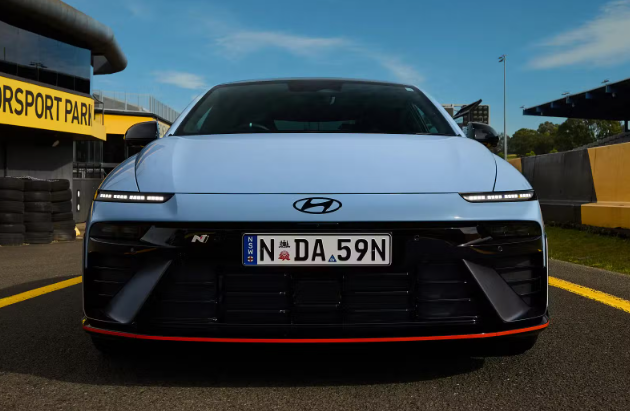
Hyundai’s second N-badged electric performance car builds on the formula introduced by the Ioniq 5 N, adding a lower stance, more adjustability and stronger track focus. With up to 650 hp, a claimed 0-62 mph time of 3.2 seconds and a chassis tuned for genuine driver involvement, the Ioniq 6 N stands out as one of the most enthusiast-focused EVs yet, even if its styling, price and real-world range may limit its audience.
Hyundai made a strong entrance into the high-performance EV segment with the Ioniq 5 N, a car that felt aimed at drivers first and spreadsheets second. The new Ioniq 6 N follows the same formula, but does so in a sleeker sedan body with a lower center of gravity, more tuning flexibility and an even sharper focus on circuit driving.
We tested the car at Sydney Motorsport Park, where it quickly became clear that Hyundai has not simply repeated the Ioniq 5 N recipe. The 6 N feels more poised, more adjustable and, in many situations, even more playful than its SUV-shaped sibling.
Key specifications
- Model: 2027 Hyundai Ioniq 6 N
- Starting price in Australia: AU$115,000 (about US$82,800) plus on-road costs
- Expected US starting price: around US$70,000
- Battery: 84 kWh
- Drivetrain: Dual electric motors
- Output: 448 kW (601 hp) and 740 Nm (546 lb-ft) standard; 478 kW (650 hp) with N Grin Boost
- 0-62 mph / 0-100 km/h: 3.2 seconds as tested
- Transmission: Single-speed
- Curb weight: 2,166 kg (4,775 lbs)
- Efficiency: 24 kWh/100 km as tested
- Dimensions: 4,935 mm long, 1,940 mm wide, 1,495 mm tall
- Wheelbase: 2,965 mm
- On sale: Now
More than a power boost
The Ioniq 6 N starts with an 84 kWh battery and a dual-motor setup that produces 601 hp and 546 lb-ft of torque in normal form. Activate N Grin Boost and launch control, and output rises to 650 hp for short 10-second bursts.
Hyundai says the car can charge from 10 to 80 percent in 18 minutes on a 350-kW DC fast charger, with peak charging rates of around 250 kW. That puts it among the quicker-charging performance EVs on sale, even if hard use will still make range the trade-off.
The chassis hardware has also been heavily revised. Hyundai lowered the roll center, added dual-layer bushings, fitted a stroke-sensing electronically controlled suspension system and installed an electronically controlled limited-slip differential at the rear. Steering response has been sharpened too, thanks to a new steering mounting bushing and the company’s Integrated Drive Axle.
Track-ready hardware and extra stiffness
Hyundai also strengthened the body shell with 44 extra weld points and 340 mm of additional structural adhesive. Braking hardware is serious as well, with 400 mm front discs and four-piston calipers, plus multiple brake-feel and regenerative braking settings.
Aerodynamics have not been ignored. The rear wing alone contributes 100 kg of downforce, helping the car stay planted at speed.
For drivers who like variety, the list of software tools is long: N Drift Optimizer, N Launch Control, N Torque Distribution, N Pedal, N Grin Boost and N Battery are all part of the package. N Torque Distribution can split power anywhere from 95:5 front-to-rear to 5:95 front-to-rear across 11 settings.
A cabin that stays usable
Inside, the Ioniq 6 N keeps the general layout of the standard facelifted Ioniq 6, but adds a more focused look. Hyundai has fitted a new N steering wheel, revised head-up display graphics, bucket seats and upgraded leather-and-Alcantara trim.
The broader interior remains one of the car’s strengths. It includes a 12.3-inch digital instrument cluster, a 12.3-inch infotainment screen and plenty of physical buttons, which is still uncommon in a segment increasingly dominated by touch controls.
That mix of usability and performance theatre helps the car feel special without making it difficult to live with every day.
How it drives
On paper, the Ioniq 6 N is fast enough to belong in rare company. Hyundai claims 0-62 mph in 3.2 seconds with N Grin Boost engaged, and our testing matched that figure repeatedly. A 60-120 km/h run took as little as 2.45 seconds.
Those numbers would have been supercar territory not long ago. What makes the Hyundai notable is that it packages them in a four-door sedan that costs far less than many top-tier performance EVs, including the Porsche Taycan Turbo, while offering a very different kind of driving experience.
Grip is immense, especially on the Pirelli P Zero Elect tires fitted as standard and the P Zero Corsa rubber used for track sessions. Acceleration is brutal, but the real surprise is the chassis balance and steering feel.
More playful than most EV sedans
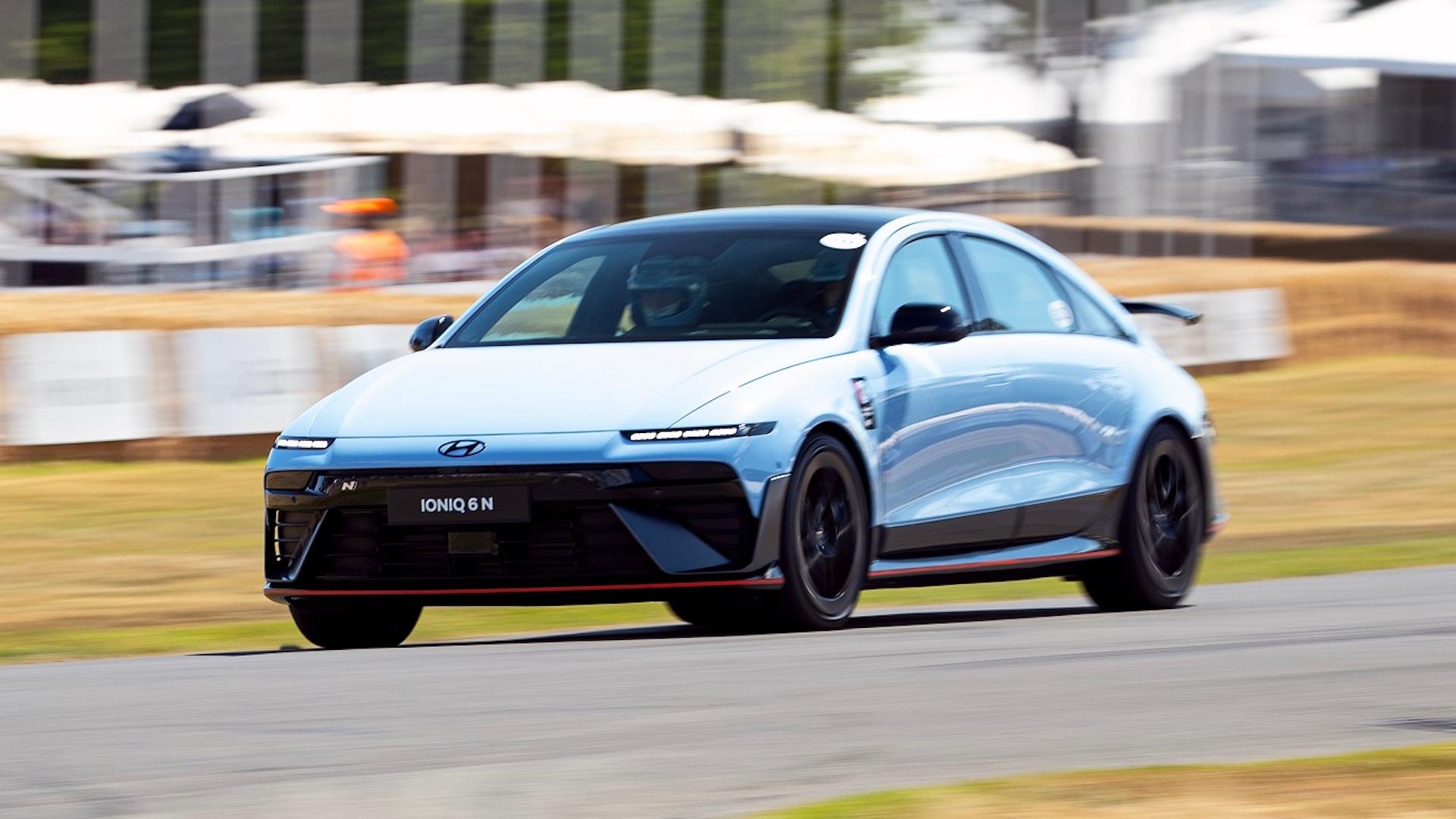
With the power split set to 50:50 and ESC in Sport mode, the rear of the car can be coaxed into gentle slides without becoming unruly. Hyundai leaves enough margin in the stability control to make the car feel approachable at the limit rather than intimidating.
Steering feedback is a standout. Despite being electrically assisted, it communicates grip levels clearly at both ends of the car, giving the driver confidence on circuit and on the road.
The car’s mass and size do eventually show up during hard track use, and the tires can begin to overheat after three or four fast laps. The test cars were also wearing tires dated to 2023, which likely did not help matters.
The fake gearbox that almost works like the real thing
Hyundai has refined its N e-Shift system, which simulates the behavior of a dual-clutch transmission. The Ioniq 5 N used seven virtual gears; the Ioniq 6 N now has eight, with shorter ratios that make the effect feel even more convincing.
The system was developed by the same engineers who created Hyundai N’s eight-speed dual-clutch gearbox for combustion models, and it shows. The shifts deliver a physical jolt and torque change that makes the car feel far more like a conventional performance car than a typical EV.
N Active Sound+ has also been upgraded. It offers Ignition, Evolution and Supersonic modes, and the new six-channel setup is richer and louder than before. Ignition in particular is said to sound close to the i30 N’s exhaust note, though the artificial engine sound still does not feel as convincing as the e-Shift simulation.
Road use and efficiency
Despite its track focus, the Ioniq 6 N is also surprisingly refined on the road. The suspension can absorb bumps well in its softest settings, yet still keeps the car composed and athletic when driven harder.
Hyundai says highway efficiency is around 19 kWh/100 km, but more aggressive driving quickly pushes that number into the 20s. On track, the battery can lose roughly 8 percent per 105-second lap without regenerative braking, or about 5 percent with regen enabled.
The brake transition between regenerative and friction braking is also well handled, avoiding the awkwardness that can affect some other Hyundai Group EVs.
Why it matters
The Ioniq 6 N matters because it shows that performance EVs do not have to feel anonymous. Many electric sports cars are defined by straight-line speed alone, but Hyundai is aiming for something more complete: balance, steering feel, adjustability and the kind of character enthusiasts usually associate with combustion cars.
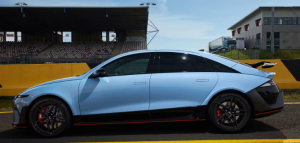
That approach has already drawn attention from brands like Ferrari, Lamborghini and Porsche, which reportedly benchmarked the Ioniq 5 N. The 6 N builds on that momentum and suggests Hyundai intends to stay at the front of the performance-EV conversation.
It is still a niche product, and Hyundai does not expect huge sales volumes. In Australia, the company says it has already received about 500 expressions of interest, although order books have not yet opened, so those numbers may not translate directly into sales.
At AU$115,000, the Ioniq 6 N is expensive for a Hyundai. But compared with premium alternatives, it offers a rare mix of pace, chassis tuning and everyday usability that should appeal to drivers who care about more than acceleration figures alone.
Why This Matters
The Ioniq 6 N is important because it challenges the idea that EV performance cars must be one-dimensional. Hyundai has built a sedan that is not only fast in a straight line, but also adjustable, communicative and entertaining on a circuit.
That matters for buyers because it widens the definition of what an electric performance car can be. It also matters for the industry, since the car adds pressure on other automakers to make EVs that feel engaging rather than merely quick.
Key Specs
- Battery: 84 kWh
- Motors: Dual electric motors
- Power: 601 hp / 448 kW standard; 650 hp / 478 kW with N Grin Boost
- Torque: 740 Nm / 546 lb-ft
- 0-62 mph: 3.2 seconds
- Charging: 10-80% in 18 minutes on 350-kW DC fast charging
- Curb weight: 2,166 kg
- Efficiency: 24 kWh/100 km as tested
- Price in Australia: AU$115,000 plus on-road costs
- Expected US price: around US$70,000
Source: Carscoops

