
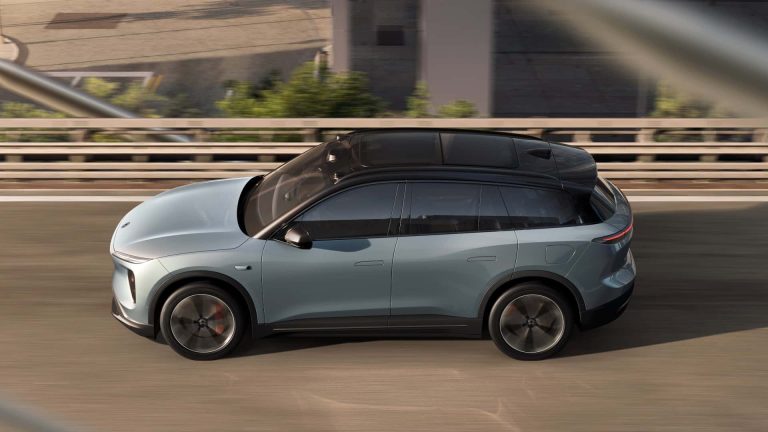
Nio founder and CEO William Li has renewed his warning about the growing weight of electric vehicles in China, arguing that ever-larger batteries are causing disproportionate damage to public roads. Speaking at the 2026 World Internet Conference, Li highlighted the urgent need for national-level policies to address the issue.
Battery Race Driving Up Vehicle Weights
William Li, founder, chairman, and CEO of Nio Inc, voiced concerns about the trend of Chinese automakers installing ever-larger batteries in electric vehicles. “Some cars are packed with 120-kWh batteries weighing 700 to 800 kilograms. The weight doesn’t matter much to the car itself, but has anyone calculated the impact on the roads?” Li said during the auto industry night forum at the 2026 World Internet Conference in Wuzhen.
He explained that increasing a vehicle’s weight by 20% more than standard results in more than double the road wear. “At 1.2 times the weight, the damage to the road is 2.07 times,” Li stated, referencing the ‘fourth-power law’ in road engineering.

Nio’s Approach: Lighter Batteries, Shorter Range
Li said Nio’s battery packs generally weigh 400 to 500 kilograms, a decision that limits battery capacity and driving range. He acknowledged this trade-off, saying, “Will we be rewarded for doing this? I don’t know.”
Nio operates an approval system for weight targets on every model, requiring Li’s personal sign-off for every additional kilogram. This approach reflects the company’s focus on balancing efficiency, range, and the impact on infrastructure.
Industry and Regulatory Response
The average curb weight of new passenger cars in China has risen sharply, from 1,312 kilograms in 2012 to 1,704 kilograms in 2024. In the first four months of 2026, the average curb weight of passenger new energy vehicles reached 1,939.3 kilograms.
Regulators have responded with new standards. An EV energy consumption limit standard, effective January 1, 2026, is the world’s first mandatory rule capping EV electricity consumption and linking limits to curb weight. The standard is about 11% stricter than the previous version, with tougher thresholds for vehicles above 2,710 kilograms. For a model weighing around 2 tons, electricity consumption must not exceed 15.1 kWh per 100 kilometers (~62 miles).
Chinese authorities are also studying tax reforms based on vehicle weight.
Calls for National-Level Guidance
Li has repeatedly called for government intervention to prevent unchecked growth in vehicle weight. In a May 2026 interview, he warned, “if China’s more than 300 million vehicles all become heavy vehicles, the roads will be crushed.” He added, “Without national-level guidance, the industry will descend into disorderly competition.”
Li also noted that many countries already levy taxes based on vehicle weight to address similar concerns.
Why this matters
The rapid increase in EV battery size and vehicle weight is not just a technical or consumer issue—it has significant implications for public infrastructure. As Li points out, heavier vehicles cause exponentially more road damage, raising maintenance costs for cities and taxpayers.
With over 300 million vehicles in China, unchecked growth in vehicle weight could lead to widespread road deterioration. National standards and potential tax reforms may soon shape how automakers design future EVs.
What this means for buyers
Buyers should be aware that the push for longer range often comes with heavier vehicles, which may face stricter regulations or higher taxes in the future. Nio’s focus on lighter battery packs could become a differentiator if weight-based policies are adopted.
Consumers may want to consider not just range and performance, but also the long-term implications of vehicle weight on costs and infrastructure.
Key Specs
- Typical Large Battery Pack Weight: 700–800 kg (~1,540–1,760 lbs)
- Nio Battery Pack Weight: 400–500 kg (~880–1,100 lbs)
- Average Curb Weight (2024, China): 1,704 kg (~3,757 lbs)
- Average Curb Weight (2012, China): 1,312 kg (~2,892 lbs)
- Average NEV Curb Weight (Jan–Apr 2026): 1,939.3 kg (~4,277 lbs)
- 2026 EV Consumption Limit (2-ton vehicle): 15.1 kWh/100 km (~62 miles)
- Cost to Reduce 1 kg in Final Development: $150 (~AUD 214)
Images sourced from: arenaev.com, cnevpost.com

