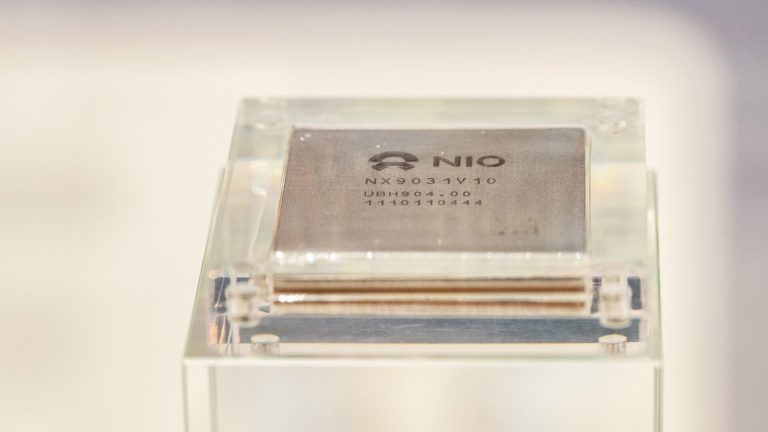
Geely is evaluating the Shenji M97 smart-driving chip, developed by Nio’s chip unit in partnership with Axera, for use in its upcoming L3 autonomous driving systems. This move could mark a significant step for Nio’s ambitions to supply advanced driver-assistance technology to third-party automakers.
Geely Considers M97 for L3 Autonomous Driving
Geely Auto (HKEX: 0175) is assessing the M97 chip for a dual-chip Level 3 autonomous driving system, according to a report from 36Kr. The M97 is the first driver-assistance chip jointly developed by Nio’s chip unit, Shenji, and Axera for external customers.
While the companies have not confirmed any supply agreement or detailed which models might use the chip, Geely’s evaluation signals growing interest in domestic high-compute solutions for smart-driving applications.
M97 Chip: Technical Highlights and Market Position
The Shenji M97 chip delivers more than 700 TOPS (trillion operations per second) of computing power, positioning it as a strong competitor in China’s smart-driving chip market. This performance surpasses the 560 TOPS offered by Horizon Robotics’ Journey 6P, a well-established local rival.
Axera previously announced that the M97 would be released in the third quarter of 2026. The chip is designed to meet the needs of automakers seeking advanced, cost-competitive driver-assistance hardware while maintaining control over their own software algorithms.
Expansion Beyond Geely: Other Interested Automakers
In addition to Geely, Leapmotor (HKEX: 9863) and Chery (HKEX: 9973) have also shown interest in the M97 chip, though details on the progress of these discussions remain undisclosed. Shenji has already made initial progress in supplying its technology externally, including securing a nomination for an edge-inference project from the Hefei government in Anhui province.
Competitor Comparison
The M97 enters a competitive field that includes Horizon Robotics’ Journey 6P (560 TOPS), BYD’s Xuanji A3, and Li Auto’s Mach 100. Horizon Robotics is a benchmark in the segment, while BYD and Li Auto have recently introduced their own high-performance smart-driving chips aimed at domestic automakers. The M97’s higher computing power and joint development approach may offer advantages for OEMs seeking customizable solutions.

Historical Context
Nio’s chip unit, Shenji, has already seen success with its in-house NX9031 smart-driving chip, which has been deployed across all Nio and Onvo vehicles. As of July 2026, cumulative shipments of the NX9031 exceeded 300,000 units.
Earlier this year, Shenji raised $335M (~AUD 468.7M) in its first funding round, resulting in a post-money valuation of $1.2B (~AUD 1.7B). Nio retains a controlling 62.7% stake in the chip company.
Why this matters
The potential adoption of the M97 chip by Geely would mark a milestone for Nio’s efforts to expand its technology supply business beyond its own vehicle lineup. As Chinese automakers increasingly seek domestic alternatives to foreign smart-driving chips, the M97 could help accelerate the development and deployment of advanced driver-assistance features across the industry.
This development also highlights the growing competitiveness of China’s semiconductor sector, particularly in the field of automotive AI and autonomous driving.
What this means for buyers
For consumers, the integration of advanced chips like the M97 into vehicles from brands such as Geely could mean more capable and affordable autonomous driving features in the near future. Buyers interested in smart-driving technology should watch for announcements from Geely and other automakers regarding the rollout of vehicles equipped with the M97 or similar domestic chips.
Key Specs
- Computing Power (M97): 700+ TOPS
- Competitor (Journey 6P): 560 TOPS
- NX9031 Chip Shipments (as of July 2026): 300,000+ units
- Shenji First Funding Round: $335M (~AUD 468.7M)
- Shenji Post-Money Valuation: $1.2B (~AUD 1.7B)
- Nio Stake in Shenji: 62.7%
- Edge-Inference Project: Hefei, Anhui province