
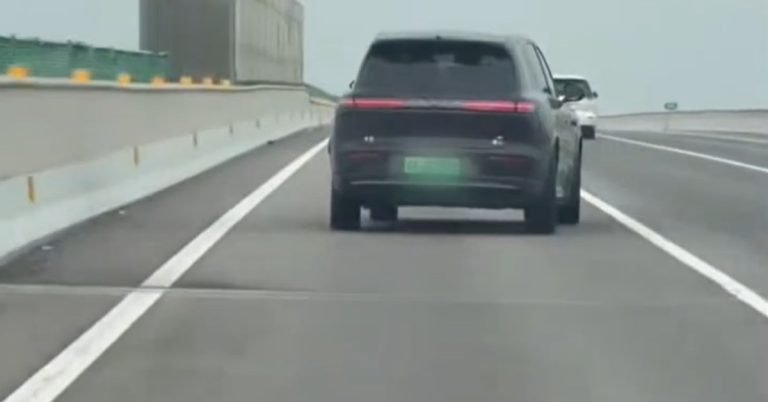
Dashcam footage circulating on Chinese social media appears to show a Voyah Taishan SUV traveling at highway speeds while moving diagonally, raising questions about the vehicle’s rear-wheel steering system. The incident has sparked discussion about the safety and reliability of advanced steering technologies in modern SUVs.
Dashcam Footage Raises Questions
Recent dashcam videos shared online show a Voyah SUV, believed to be from the Taishan series, driving along a highway with its body angled relative to its direction of movement. While the exact model is not confirmed, the footage has led to speculation about the vehicle’s directional control and the function of its rear-wheel steering system.
The video does not provide verified data on speed, wheel position, or driver input, making it difficult to determine the precise cause of the unusual trajectory.
Voyah Taishan’s Rear-Wheel Steering System
Dongfeng Voyah equips the Taishan with a bidirectional rear-wheel steering system, capable of turning the rear wheels up to 16 degrees in either direction. This feature is designed to reduce the SUV’s turning radius to a minimum of 5.4 meters (~17.7 feet), enhancing maneuverability.
At low speeds, the system typically turns the rear wheels opposite to the front wheels to tighten the turning circle. At higher speeds, some systems may steer the rear wheels in the same direction as the front to improve stability, though the exact strategy and angles can vary by model.
Potential Causes and Safety Implications
One possible explanation for the observed movement is a rear-axle thrust-angle offset, where the rear wheels are misaligned with the vehicle’s centerline, causing diagonal tracking. Such misalignment can require constant steering correction and may increase tire wear and heat.
Sustained diagonal tracking at highway speeds is considered abnormal and could pose risks to surrounding traffic. However, without diagnostic data or a physical inspection, the exact cause remains unconfirmed.

Previous Rear-Steering Incident Reported
In September, Chinese media outlet Xinwang reported a separate incident involving a Voyah Taishan X8 in Wuhan, where a rear-wheel-steering failure warning appeared just one day after delivery. The dealership initially attributed the issue to the rear-steering assembly and recommended replacement. The owner and dealership later reached a settlement.
It is important to note that this earlier case involved a different model and does not establish a direct link to the highway incident captured in the recent footage.
Competitor Comparison
The Voyah Taishan competes in the premium SUV segment, where advanced chassis technologies are becoming more common. Key rivals include the Li Auto L7, Aito M7, and BYD Tang DM-i, all of which offer their own takes on maneuverability and safety features. While rear-wheel steering is a standout for the Taishan, competitors focus on integrated hybrid systems and autonomous driving hardware.
Historical Context
Voyah has experienced rapid growth, with sales reaching 150,169 units in 2025, representing an 87% year-on-year increase. The brand aims to achieve 200,000 units sold in 2026. The previous Dreamer model was priced at around $59,797 (~AUD 85,103), positioning Voyah in the higher end of the Chinese SUV market.
Regional Availability
The Voyah Taishan is currently available in China, with the manufacturer targeting expansion in both domestic and select international markets. Its advanced features are intended to appeal to buyers seeking premium technology and maneuverability.
Why this matters
The incident highlights the complexities and potential risks associated with advanced steering systems in modern vehicles. As more automakers introduce technologies like rear-wheel steering, ensuring robust safety and diagnostic protocols becomes increasingly important.
With Voyah’s rapid sales growth and ambitions for higher annual volumes, maintaining consumer confidence in the reliability of its technology will be crucial for continued success.
What this means for buyers
Prospective buyers should be aware of the benefits and potential challenges of advanced steering systems. It is advisable to monitor manufacturer updates and service bulletins, especially for new or complex features.
Comparing the Voyah Taishan with competitors such as the Li Auto L7, Aito M7, and BYD Tang DM-i can help buyers make informed decisions based on their priorities for safety, technology, and after-sales support.
Key Specs
- Rear-Wheel Steering Angle: 16 degrees (bidirectional)
- Minimum Turning Radius: 5.4 meters (~17.7 feet)
- Length: 5,230 mm (~206 inches)
- Width: 2,025 mm (~79.7 inches)
- Height: 1,817 mm (~71.6 inches)
- Wheelbase: 3,120 mm (~122.8 inches)
Images sourced from: carnewschina.com

